Tampilkan postingan dengan label mobile update. Tampilkan semua postingan

Sabtu, 12 Maret 2011

Changes the Game with Low Cost High End Android Phone

Android phones come in two flavors: high-end and low-end. High-end phones usually end up with a price tag between US$500 and US$600 off-contract. If you want them cheaper you can generally get them subsidized when you contract with your carrier for two years. Generally that brings your price down to the US$150 to US$250 range.
Low-end phones can be had for around half the price of their high-end siblings.

On the larger carriers, that two year contract generally includes signing up for a data plan, which is likely going to cost you around US$50 to US$70 per month, plus voice, plus text, plus some "privilege of being their customer" fees.

Cricket, on the other hand, is a different kind of carrier. They don't force you into a contract, and they have a flat monthly cost. The catch? The phones aren't subsidized and the coverage isn't as broad as the larger carriers.

Regarding the phones, generally Cricket phones have been regarded as "cheap". They get the job done, but that's it. Why? People don't generally want to fork out a big chunk of change when they sign up for a phone -- apparently they'd rather have much more than that squeezed out of them over time.

What does this have to do with Android? According to Market Watch, Cricket is changing the game with their newly announced phone, powered by Android.

The phone in question is the Huawei Ascend, which is being touted as "the first low-cost Android device to hit the Smartphone market in the United States".

The Ascend will be available in mid-October for around US$149.99. That doesn't sound all that great until you realize that it's off-contract. You don't have to commit two years of your life to a carrier that you may end up hating. You're free to leave at any time. Additionally, your monthly bill will be astoundingly low: US$55, which gives you unlimited talk, text, 411 information, navigation, and unlimited 3G data.

The Ascend sports a 3.5" HVGA touch-screen, WiFi, 3.2MP camera, and runs on Android 2.1.

Jumat, 11 Maret 2011

Apple iPhone Specifications


Network

Technology / Frequency Bands GSM : 850/900/1800/1900 MHz

Battery

Type Li - Ion
Capacity mAh
Standby 250 hours
Talktime 480 mins

Built

Dimensions 115x61x11.6 mm
Weight 135 g
Antenna Type Internal
Form Factor Unique
Colors Black
Touch Screen yes

Display

Size 320x480 pixels
Type color : TFT
Colors 16000000 colors
Secondary Display no

Camera / Imaging / Video

Camera Yes Inbuilt 2.0 Megapixel
Resolution 1600x1200 pixels
Resolutions Supported 1600x1200 pixels
Zoom no
Flash no
Secondary Camera no

Connectivity

Bluetooth Yes , version 2.0 + EDR
Irda No
Wlan/Wi-fi Yes Modes: 802.11b / 802.11g
Pc Sync no
SyncML no
USB yes
GPS no

Data

Data Modes GPRS / EDGE (EGPRS)
GPRS Yes
EDGE Yes
3G No
Internet Browsing , Safari

Media

Audio Playback Yes
Audio Formats MP3
Video Playback Yes
Video Formats MPEG-4
Ringtones
FM Radio No

Memory

Inbuilt 4 GB
Memory Slot No
PhoneBook

Messaging

SMS Yes
MMS Yes
Email Yes

Calling / Voice

Software

Java n/a
Games yes

Kamis, 10 Maret 2011

iOS 4.3, Planned For Friday, Available Now

Even with its mobile devices flying off the shelves, Apple needs to keep its competitive edge and iOS 4.3 is part of that strategy. A January survey showed that as of last November iOS was still the leading operating system in the US but losing ground to Google's Android. So, the release of new features in iOS 4.3 is critical.Two days before the release of the new iPad Relevant Products/Services, Apple launched the latest version of its mobile operating system Relevant Products/Services earlier than expected.

iOS 4.3, originally set for Friday, will allow AT&T's iPhone users to access Relevant Products/Services the personal Wi-Fi hotspot feature that Verizon Wireless users received off the bat when the CDMA version became available in January. But the update which includes faster browsing via a new Nitro JavaScript engine, won't reach Verizon iPhone users until later this year.

More Sharing And Streaming

Other 4.3 features include iTunes Home Sharing, allowing users to stream their iTunes libraries to any iOS device Relevant Products/Services via a shared Wi-Fi network; the ability to stream content from any compatible app to an Apple TV set-top device via AirPlay; and iPad side switch customization, which allows users to choose whether the mechanical side switch is used as a volume mute button or to lock the screen rotation.

Many of the features were displayed by Apple's CEO Steve Jobs on March 2, when he came out of medical leave to show off the iPad 2, the first device to ship with 4.3 and not require the update. Users of the iPhone 3GS or 4, original iPad or the two most recent versions of the iPod touch can go to Apple's web site now, connect their device and click on check for updates.

If you haven't updated your iOS in a while, 4.3 will also include past additions, such as Air Print -- the ability to send photos from mobile device to stationary printer Relevant Products/Services -- drag and drop folders and the remote device finder, which also allows remote passcode setting.

The update follows the Tuesday release of iTunes version 10.2.1, which iOS users will need to get the new firmware.

Why Wait?

Apple likely released the update early simply because it saw no reason to hold it once the finishing touches were complete, said mobile devices analyst Avi Greengart of Current Analysis.

"It's software, so there are no channel issues to launch timetables, you just post it on your site," said Greengart

Even with its mobile devices flying off the shelves, Apple needs to keep its competitive edge. A January survey Relevant Products/Services by market research firm Nielsen Group showed that as of last November iOS was still the leading operating system in the United States but losing ground to Google's Android, which is available on numerous devices and tablets and sold by many carriers.

Just two months later, Nielsen found that in the intervening period, through January, Apple was tied with Research in Motion's BlackBerry for second place, at 27 percent each, with Android seizing the lead with 29 percent of active smartphones. (That was before Apple released the iPhone for Verizon Wireless.)

One potential point of concern for Apple is that new smartphone Relevant Products/Services adopters, those ages 18-34, were found to be more likely to choose an Android phone.

Senin, 28 Februari 2011

Apple's March Madness: In Like a Lion

Apple kicked off what looks to be a few weeks of big news by putting a new line of MacBook Pros on the shelves as well as giving developers a new OS X Lion preview. News about iPad 2 and iOS 4.3 is expected soon. Meanwhile, a WinPho 7 update snuffed some phones, Amazon ruffled Netflix's feathers and Apple's board scuffled with investors.If you nauseate easily at the prospect of non-stop Apple (Nasdaq: AAPL) announcements, right now might be a good time to take a long hike in the woods, weather permitting. Apple's given developers a brand-new preview of OS X Lion; next week we'll see an announcement that's almost certainly going to be all about iPad 2; and there are rumors that iOS 4.3 is just around the corner.

Previews and just-about-there hearsay aside, Apple also pulled off an actual product release this week. A new batch of MacBook Pros washed ashore, and in terms of design, they're really very similar to last year's models. There were a few notable steps forward, though, including a new technology Intel (Nasdaq: INTC) has been talking up over the last few months.

But first, processors: All three models -- 13, 15 and 17 inches -- have Intel's latest Core processors, and the bigger two offer quad-core options. In graphics, the larger models have ditched Nvidia (Nasdaq: NVDA) and jumped over to AMD's (NYSE: AMD) camp.

Apple's also polished up the webcam to provide 720p HD video-calling abilities. You can use FaceTime, too, if you happen to have an extra dollar.

Then there's Thunderbolt, the new input/output system built on Intel's Light Peak technology. It's all about fast data transfer speeds -- up to 10 gigabits per second. So you can move lots of data into and out of the computer -- as long as that other data bucket happens to be have a Thunderbolt port as well. Several companies say they have stuff on the way, but it's going to be a while before you'll find it everywhere you turn.Everyone's Gone to the Movies

There are two kinds of Amazon (Nasdaq: AMZN) Prime members: 1) People who buy lots of stuff on Amazon and figure they probably save money by paying a flat $79 per year to get free express shipping on anything, any time; and 2) People who signed up for a free one-month membership in order to save a few bucks shipping one item, then forgot to cancel the automatic renewal.

But Amazon's Prime membership isn't just about shipping; the latest perk the retailer's given its VIPs is movie streaming. Anyone familiar with Netflix's (Nasdaq: NFLX) system should recognize how it works: Choose the night's entertainment from a catalog of thousands of movies and TV shows, then just sit back and watch, commercial-free, either through a computer or any of the various set-top boxes that already work with Amazon's video download service. No limits as far as Amazon's concerned, though your ISP might have a different theory about that.

Amazon's providing this at no extra charge above the annual fee Prime members already pay. And it just so happens that the fee actually comes out to a few bucks less than what Netflix charges for 12 months of its own streaming-only plan.

But you can't call Amazon's offering just flat-out better than Netflix's, not yet anyway. For one thing, Amazon's streaming library is about 5,000 titles strong; the Netflix instant catalog is about five times that amount. Also, there's no sign Amazon is about to budge from its annual membership system and open up some kind of pay-by-the-month offering. Maybe they figure they'd get too many hop-ons. So after that first free month, new users will have to commit for a full year.

Finally, Amazon currently offers no way to stream video directly to a mobile device through an app. Netflix, on the other hand, has an iOS app -- though that's exactly the kind of app that seems like it could quickly suffocate if Apple intends to enforce its new subscription rules across the board, not just for magazines and newspapers.
Fail Deadly

Microsoft's (Nasdaq: MSFT) plans to keep a foot in the mobile game with Windows Phone 7 are well under way, and it even has the massive, hulking Nokia (NYSE: NOK) on its side. But in terms of basic mobile OS childhood development, WinPho 7 has a few skills it still needs to acquire in order to catch up with the rest of the class.

One of these is copy and paste. Might not be a feature everyone uses all the time, but it's sort of the technological equivalent of being able to dress and feed yourself -- if you don't know how to do it, the perception is that you're definitely behind the curve.

Perhaps copy and paste were what a lot of Windows Phone 7 users were hoping for when they started installing the OS's latest update this week. It's not what they got, though -- this update seemed to be focused on improving the update process. A meta-update, or something.

And that's if the whole exercise worked properly. But as some owners of Samsung Windows Phones soon learned, the process was not universally smooth. Some reported that it kept freezing up mid-stride, and in certain cases, it more or less bricked their phones -- in other words, scrambled their firmware so bad they were rendered inoperable. Microsoft quickly pulled the update from Samsung models.

Some feel that Microsoft really ought to graduate to a system that does over-the-air updates, where you don't have to plug your phone into a computer in order to get the latest version of the OS. That might have its advantages from a convenience perspective, but if the software's botched to begin with, it doesn't matter what the phone is or is not plugged into; its brains are still gonna get scrambled.

Over-the-air is no guarantee against defective updates. I remember that last summer, Sprint's (NYSE: S) EVO 4G, an Android phone from HTC, had its own little problem with a bum update, and that one was done over-the-air. If you have to plug it in, at least you might have a chance to back up and create a restore point -- if the management software's designed that way.
It'll Probably Come Down to a Game of Snooker

Much doubt has been raised about Apple CEO Steve Jobs' role at the company right now. Technically he's on a leave of absence, putting COO Tim Cook in charge. Tabloids report his health issues have taken a turn for the worse. Yet he's said to be calling Apple's major shots from home, he was well enough to join a who's-who-in-technology dinner with President Obama last week, and those cryptic, one-liner responses to random emails from the public are still trickling in every now and then.

Just like the last time Steve Jobs had to take a major break from full-time duties, his absence has made some shareholders very anxious. They want to know what the board's plan is for when Jobs isn't in charge anymore, whether that happens tomorrow or many years from now. Will Cook officially take over immediately, or will the job be open to applicants? Will it only consider current top Apple execs, or will there be some outside head-hunting? Or will it reorganize into some kind of new-agey council of elders where no one person officially wears the turtleneck?

Apple's board says it does indeed have a plan, and it's not difficult to believe that's true. Not having any kind of plan at all would be so fiscally irresponsible that it makes me wonder whether someone might end up in jail over it. So the board knows what it'll do; it just doesn't want to talk about it publicly.

Not all shareholders agree with that strategy, though, and the issue came to a head this week at a shareholder meeting in which the board squared off with the Laborers' International Union of America, backed by Institutional Shareholder Services. LIUNA wants that succession plan publicly known, and it put it up for a shareholder vote.

Apple's board is thoroughly against this; it maintains that disclosing its plan would hurt its ability to recruit and retain top executives. Those who see that they're clearly nowhere near on the right track to the crown might be less inclined to work with Apple. Apparently that's what most shareholders think too; preliminary results indicate the board won the standoff.

Not exactly surprising -- Apple's one of the most secretive publicly traded companies on Earth. It's also been one of the most successful over the past decade or so. Hard to say whether that's because of all the secrecy or in spite of it, but it seems most Apple shareholders are happy enough with its performance that they'll allow the board to keep yet another secret tucked away if that's what it thinks is best.
Metabolic Frolic

You always hear about how much tougher previous generations were, how they worked harder and put up without the comforts we take for granted today. But I say the people who are alive today are pretty tough too, in our own way. We gobble up fish saturated with mercury, we breathe air full of toxic exhaust fumes, we walk around under a depleted ozone layer, and a lot of our food is so heavily processed it would hardly be recognizable to someone from 200 years ago. Yet our life expectancy is still greater than it was back when it was all blue skies and clean living. Progress!

We can even take a radiological kick to the head without even blinking, which is kind of what happens every time you use a cellphone. The thing making it work is a microwave radio that uses the same frequency as a microwave oven, and although it probably won't boil your brain matter in two minutes, it still does a little something to your gray goo, according to recent research. What that something is, and whether it's good, bad or indifferent, is still unclear.

For the study, researchers pumped 47 people with a fluid used to measure brain glucose metabolism, then strapped phones to their ears and let 'em rip for about an hour. Then they monitored them for the same amount of time with the phones turned off.

What they found was that metabolism in the brain region closest to the antenna was 7 percent higher when the phone was on. They said that suggests the human brain is indeed sensitive to the kind of radiation cellphones put out.

What's more difficult to figure out is exactly how harmful that is, if at all. It might be more dangerous to younger people whose brains are still developing, and adults with neurological problems or brain injuries. But the technology's still too new to know the full life-long affects of cellphone use, if any.

It's been a quarter century since Gordon Gecko wowed the world with his fruitcake-sized Motorola (NYSE: MOT), but it'll be at least that much longer before we'll know exactly what happens to a human brain after using a cellphone daily from adolescence well into adulthood.

Sabtu, 26 Februari 2011

new high speed Thunderbolt connector from intel

Chip manufacturer Intel has announced it is to roll out a new technology for connecting computers and peripherals.

The system, known as Thunderbolt, promises transfer speeds twice as fast as USB 3.0.

However it won't reach its theoretical maximum because Intel has opted to use copper wires rather than fibre optic cables.

The company said it would gradually move to higher speeds over time.

Apple will become the first manufacturer to use Thunderbolt, on its Macbook Pro computers.

The Cupertino firm is said to have been a major driver of its development, although it remains to be seen how may other manufacturers will adopt the new standard.
Light Peak

Intel has been working on the technology for several years.

It was first announced, under the codename Light Peak in 2009.

At launch, its top speed will be limited to 10 Gigabits per second - twice as fast as USB 3.0, but still well below the theoretical maximum using optical cables.
Continue reading the main story
Computer connections
Thunderbolt connector


Intel claims that future versions will be able to reach 100 Gb/sec.

The faster data transfer rates are likely to be welcomed by those consumers who use high-definition video, said Sarah Rottman Epps, an analyst with Forrester Research.

"This isn't an innovation that consumers have been asking for, but it's one they'll appreciate," she said.

"Especially when transferring video, as that's when [USB] starts to feel slow."

The system also promises to reduce the number of cables a user has connecting their computer setup.

It is able to carry multiple signal types at the same time, enabling power, display and peripherals to use a single cable.

However, in the short term, users may need to invest in special adaptors to connect their older devices onto Thunderbolt sockets.

Its arrival on the consumer market also raises questions about the future of other connector standards, such as USB and Firewire.

Thunderbolt's most high profile supporter, Apple, is expected to gradually transition to a single connector, according to Karen Haslam, editor of Macworld UK.

"In the long run there will be no need for Apple to support these multiple formats with individual ports - existing products can run through an adaptor," she said.

Not everyone is convinced that Thunderbolt will become the lone standard.

Ian Chiu, editor of the website Everythingusb.com told BBC News that the cost of components could put off some manufacturers.

"I don't really know how Intel will make Thunderbolt appealing to all the other first-tier PC manufacturers," he said.

"HP, Sony, Dell, Acer, Asus make most of their money from the low-end and medium-end notebooks.

"On the other hand, Apple's Macbook Pro line-up is targeted at the prosumers, professionals and other people who aren't so price conscious," said Mr Chiu.


* All methods for connecting computers to external devices have a theoretical top speed for transferring data
* USB 2.0 - 480 Mb/second
* Firewire 800 - 800 Mb/second
* USB 3.0 - 4.8 Gb/second
* Thunderbolt copper - 10 Gb/second
* Thunderbolt fibre optic - 100 Gb/second

Cell Phone Network Could Create GPS in Dead Zones

The FCC has given approval for LightSquared to build 40,000 new high-speed 4G mobile wireless protocol base stations that would broadcast much stronger signals, but engineers with GPS manufacturer Garmin say this will seriously damage GPS reception, causing widespread, severe GPS jamming and the loss of GPS service over vast areas.A proposed faster U.S. cellphone network could interfere with global positioning systems, creating GPS "dead zones" across the country, researchers say.

GPS satellites transmit their navigation signals in the range 1559 to 1610 megahertz, close to the frequency band used by U.S. telecom company LightSquared, which communicates with its satellites in the 1525 to 1559 megahertz range known as the "L" band, NewScientist.com reported Tuesday.

Despite the closeness of the frequencies, GPS receivers have operated without any interference problems -- up to now.

In January the Federal Communications Commission gave preliminary approval for LightSquared to build 40,000 new high-speed 4G mobile wireless protocol base stations on the ground that would broadcast much stronger signals in the 1525 to 1559 MHz range to link to cellphones.

Engineers with GPS manufacturer Garmin International in Olathe, Kan., say this will seriously damage GPS reception and that it "will result in widespread, severe GPS jamming [and] will deny GPS service over vast areas of the United States."

LightSquared spokesman Jeff Carlisle responded by saying it is the GPS receivers, not his company's base stations, that are at fault.

"The issue is that some GPS receivers may be able to see into the L band where we operate," he said.

LightSquared has until Feb. 25 to submit a plan to the FCC for working with the GPS industry and federal agencies to analyze interference issues, NewScientist.com reported.

© 2011 United Press International under contract with MarketWatch. All rights reserved.

Sony dropping PSP price to $129

Sony has substantially cut the price of its PlayStation Portable.

Starting Sunday, consumers can get their hands on the portable-gaming device for $129.99--the same price as the Nintendo DS Lite. The PSP currently sells for $169.99.

In addition, Sony has added 13 titles, including Assassin's Creed Bloodlines and Dissidia Final Fantasy, to its "Greatest Hits" and "Favorites" lines of games. Titles in the Greatest Hits list will retail for $19.99, while titles in the Favorites line will go for $9.99.

Sony has shipped 23 million PSP units to the U.S. and 67.8 million units worldwide since the device launched in 2005. North American customers have a catalog of 590 games, the company said today.

The decision to drop the price may result from Sony's diminishing sales of the device over the past year. Sales in the U.S. have been easily overshadowed by Nintendo's DS, the leader in the mobile-gaming space.

Wedbush analyst Michael Pachter reported last week that he believes Sony sold just 80,000 PSP units in the U.S. last month, down 20 percent from January 2010. Last August, the final month in which market researcher NPD publicly reported hardware sales figures, Sony sold just 79,400 PSP units. It had sold 140,300 PSP units in August 2009.

The PSP has also let down video game retailer GameStop. Bob McKenzie, the retailer's senior vice president of merchandising and marketing, said late last year that the number of titles released for the PSP in 2010 was a "disappointment."

In an attempt to change its luck in the mobile market, Sony unveiled the Next Generation Portable in January. The device is a follow-up to the PSP and includes dual thumbsticks, 3G connectivity, a touch screen, and two cameras. It also comes with an improved display over that of the current PSP. Sony said at the time that the platform would feature PlayStation 3-like graphical capability.

The new device is scheduled to launch at year's end.

Lion Scopes Out Territory in Apple Ecosystem

Apple's newest iteration of OS X, Lion, includes some features inspired by iOS, the system designed specifically for the iPhone and iPad. Like iOS, Lion comes with an app store built in. One burning question is whether Apple will make an effort to corral most -- if not all -- of the software developed for OS X and make it available only through the Mac App Store, a move that would most likely be viewed as too controlling -- even for Apple.Apple (Nasdaq: AAPL) may be hoping that Mac operating system release number eight becomes the eighth wonder of the technological world. The company released a developers preview of the OS, code-named "Lion," on Thursday.

However, Lion is primarily a "user interface evolution rather than a back-end functionality upgrade," according to Appitalism founder and CEO Simon Buckingham. Mac OS X Lion features Mission Control, a new Mac view; Launchpad, a new app home; full screen apps that use the entire Mac display; and of course, the new Mac App Store.

Mission Control provides a "bird's eye view of every app and window running on your Mac," said Apple representative Monica Sarkar. "Launchpad makes it easier than ever to find and launch any app. Multi-touch gestures give you a natural and intuitive way to interact, like pinching your fingers to zoom in and swiping left or right to turn a page."

Mac OS X Lion - Mission Control
iPad Inspiration

With the wild popularity of its iHandhelds -- iPad, iPhone and iPod -- it's no wonder Apple is incorporating a slew of iOS features into OS X.

"The iPad has inspired a new generation of innovative features in Lion," said Philip Schiller, Apple's senior vice president of worldwide product marketing.

Those features come with a dizzying array of trademarked monikers. "Conversations" automatically groups related messages into a single timeline. "AirDrop" copies files wirelessly from one Mac to another.

"Versions" automatically saves successive versions of a document, with additional browse, edit and revert options. "Resume" brings apps back exactly as they were left on quit or restart. And "FileVault" provides disk encryption for local and external drives, along with the ability to wipe data instantaneously.

"I suspect all these new features hint at an accelerated announcement pace," Appitalism's Buckingham told MacNewsWorld. "Apple will probably move to twice yearly OS and iOS updates so that Android doesn't catch up to them."
App Store Roar

The new Lion features could hint at tighter controls over Mac software -- even more restrictive, perhaps, than those that apply to the iOS App Store.

Still, Lion and Apple iDevices are different animals, said Herbert Tsang, Ph.D., a bioinformatics researcher and instructor at the Simon Fraser University School of Computing Science.

"Through the App Store, the tight control that Apple has over their iDevices software is notorious," Tsang told MacNewsWorld. "There is no indication, however, that the [Mac] App Store will be the only way to obtain Mac software."

Mac OS X Lion - Mac App Store

A Lion roaming in Apple's pristine ecosystem might also suggest that even higher walls are on the way. However, the act of building those walls would likely leave clues, "such as making iOS apps seamlessly available on the Mac platform, which is what I'd be looking for if I thought Lion involved issues of increasing control," Appitalism's Buckingham told TechNewsWorld. "I don't see any of that, however."

In fact, coupling the Mac App Store too tightly and seamlessly to the Mac would be a "step backward" in the progress of technology, SFU's Tsang remarked.

Simply having an app store available on a Mac, however, "is a way for individual developers to sell their software and will be a great benefit," he said. "The new integration ... in Mac OS X Lion is a way to benefit individual software developers. It is an effort to offer alternatives, rather than exclusivities.

Jumat, 25 Februari 2011

Roll of Distant Thunder Ushers In New MacBook Pros

Apple has released a new line of MacBook Pros with faster processors, sharper webcams and a new I/O technology called "Thunderbolt," based on Intel's Light Peak. It facilitates super-fast data transfers -- up to 10Gbps. While a few Thunderbolt-ready accessories are in the works, it may be some time before the technology is truly ubiquitous.Optimize software licensing, boost cyber security. Click for white paper & demo.

Apple (Nasdaq: AAPL) on Thursday announced four new MacBook Pros with next-generation processors and graphics; high-speed Thunderbolt input/output technology; and new FaceTime HD cameras.

MacBook Pros
Apple's 13-inch, 15-inch and 17-inch MacBook Pros

These run on the latest dual- and quad-core Intel (Nasdaq: INTC) Core processors and are claimed to be up to twice as fast as their predecessors.

Thunderbolt is a technology Apple codeveloped with Intel, which calls it "Light Peak."

Apple also released the developer preview of Mac OS X Lion Thursday. This includes features from the iPad's iOS operating system.

The initial reception for the new MacBook Pros may not have been as warm as Apple expected.

"I can't see anything that's really that revolutionary except maybe Thunderbolt," Jim McGregor, chief technology strategist at In-Stat, told MacNewsWorld. "The newest version of their operating system is really the most interesting thing," he added.

"Thunderbolt will handle multiple DisplayPorts, and that's big news for analysts who need to look at lots of data at once," Carl Howe, director of anywhere consumer research at the Yankee Group, told MacNewsWorld.

Apple did not respond to requests for comment by press time.
Reading the MacBook Pro Specs

There are three new MacBook Pros, with screen sizes of 13, 15 and 17 inches.

The 13-inch version features either a dual-core Intel Core i5 or i7 processor with a speed of up to 2.7 GHz. It also has an Intel HD Graphics 3000 processor.

The 15- and 17-inch models have quad-core Intel Core i7 processors rated at up to 2.3 GHz. Apple's spreading the love with graphics processors, using the AMD (NYSE: AMD) Radeon HD graphics processors with up to 1GB of video memory in these larger MacBook Pros.

"More cores are good for battery life," Howe stated.

All three models of the new MacBook Pros will include a built-in FaceTime HD camera with triple the resolution of the previous generation of the camera, Apple said. This allows HD video calling between all new MacBook Pro models. It supports standard resolution video calls to other Intel-based Macs, the iPhone 4 and the current-generation iPod touch.

However, Apple didn't state whether it was referring to the GSM version of the iPhone 4, offered by AT&T (NYSE: T); the CDMA version, which is from Verizon Wireless; or both.

All three MacBook Pros will have aluminum unibody enclosures, glass multitouch trackpads, LED backlit widescreen displays, illuminated full-size keyboards, and batteries offering 7 hours of life between charges, depending on how the laptops are used.

Pricing for the 13-inch MacBook Pro will begin at US$1,200. The 15-inch MacBook Pro will start at $1,800 and the 17-inch version at $2,200.

Optional add-ons include faster quad-processors, additional hard drive capacity, solid-state storage up to 512GB, up to 8GB of DDR3 memory, and 'antiglare and high-resolution displays, Apple said.
Releasing the Thunderbolt

The new MacBook Pros also include Thunderbolt I/O technology codeveloped by Apple and Intel.

This features two bidirectional channels with transfer speeds at up to 10Gbps (gigabits per second) each.

Thunderbolt uses two protocols -- PCI Express for data transfer and DisplayPort for displays. It is compatible with existing DisplayPort displays and adapters, Intel said. All Thunderbolt technology devices share a common connector and let users daisy-chain up to six peripherals with electrical or optical cables.

Thunderbolt delivers PCI Express directly to external high-performance peripherals such as RAID arrays. It can support FireWire and USB consumer devices and gigabit-speed Ethernet networks through adapters, Apple stated.

"The storage guys would be happy; imagine what NAS [network-attached storage] guys could do with data transfer speeds like this," In-Stat's McGregor remarked. "But this applies more to corporate than consumer solutions."

Thunderbolt technology requires an Intel controller chip and a small connector for mobile devices that will be included in products supporting the technology. The controller chip provides protocol switching capabilities to support PCI Express and DisplayPort over a single cable.

Avid, Blackmagic, LaCie, Western Digital (NYSE: WDC) and Apogee are among the companies that have either announced products based on Thunderbolt technology or plan to support the technology in future devices, Intel stated.
Is Thunderbolt Ready for Prime Time?

Intel hasn't quite lived up to its promise of making Thunderbolt an optical technology. At the Consumer Electronics Show, held in Las Vegas January, Intel executive David Perlmutter said that the initial builds will be based on copper.

Copper's good enough for the majority of user needs today, Perlmutter said.

However, copper wires limit the speed and range of data transmission.

"Intel's whole thing with Light Peak is to enable optical interconnections, because you get over lots of limitations in terms of speed and distance imposed by copper," In-Stat's McGregor pointed out.

However, connectivity is going to be a problem for some time, McGregor warned.

"Nobody has external PCI Express ports on their PCs, or any peripherals that will connect to Light Peak," McGregor said. "How long is it going to be before your PC and TV and your peripherals support Light Peak? It might be years."

Although Intel's Perlmutter struck a conciliatory note when talking about Light Peak at CES -- he said it could coexist with USB 3.0 and run USB, display and networking protocols on top of it -- Apple took a more combative stance.

Thunderbolt technology is expected to be widely adopted as a new standard for high-performance I/O, Apple said when announcing the new line of MacBook Pros.

Intel did not respond to requests for comment by press time.

Selasa, 22 Februari 2011

Say Happy Birthday To IPod

On this day exactly nine years ago, iPod was released into the world. And nine years later, it is the most popular music device if not the most popular device ever. The first model was a Mac-compatible device with a 5 GB hard drive and a capacity that put, in the words of Steve Jobs, “1000 songs in your pocket.” Since then, we’ve seen the ever so popular iPod Touch, the iPod Nano, and the shuffle. The iPod even has some popular siblings now, the iPhone and iPad, both of which include and expand upon the media player roots of the iPod family. And also to this day, Apple has sold over 260,000,000 worldwide. Making it the most popular and most used music device on the plant. And on that, we wish the Apple iPod a very Happy Birthday!

e-wallets car in mobile phone

BARCELONA, Spain--Later this year you'll be able to pay for clothes, taxi fare, and dinner with your mobile phone and leave your credit cards and cash at home.

Visa is planning a commercial rollout in the U.S. in the second half of this year of a service for allowing allow people to turn their existing smartphones into electronic wallets. It uses Near Field Communication (NFC) short-range wireless technology and includes real-time anti-fraud alerts and other features designed to protect consumers from fraud, Bill Gajda, global head of Visa Mobile, told CNET in an interview at Mobile World Congress 2011 here this week. Visa was demonstrating its PayWave mobile payment system at the show.

Despite the promise of convenience and ease of use, the e-wallet industry has gotten off to a sluggish start as mobile handset makers have dragged their feet on adopting NFC technology and retailers saw no need to install mobile payment readers if the phones weren't yet equipped. In 2008, the GSMA, a trade association representing the Global System for Mobile Communications industry, called on manufacturers to embed NFC chips in phones by late 2009 and three years later they are trickling out.

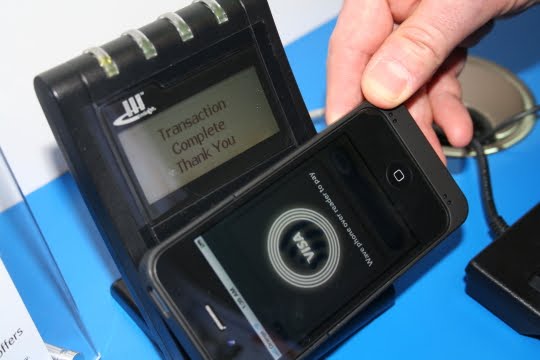
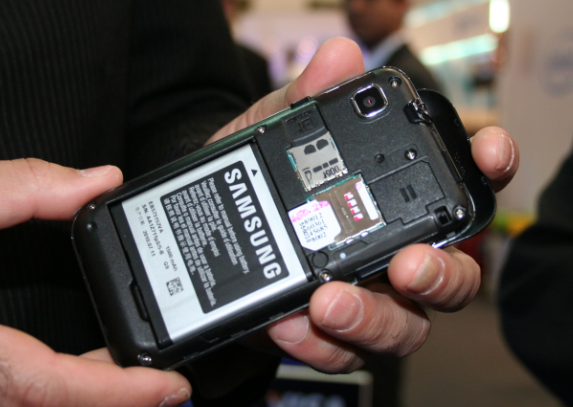
Rather than wait, Visa is offering a way to use existing smartphones by inserting a microSD (Secure Digital) removable memory card into the SD slots in the back of phones and, for the iPhone, in a special plastic skin. The card works in conjunction with Visa's PayWave downloadable app. Wells Fargo, Chase, U.S. Bank, and Bank of America have trials going with the technology in the U.S. (Another interim solution has been stickers affixed to mobile devices that allow for payments.)

"People don't want to wait two years for NFC-enabled phones to come out or to switch phones," to get one with an NFC chip sooner, Gajda said. "You can make payments today on the iPhone 4."

The terminal reader device is based on standardized technology so that it can work with Visa's PayWave system as well as MasterCard's PayPass and Express Pay from American Express. At this time, only Visa is offering an external memory card solution so phones that don't have NFC chips yet can be used--which is key to jumpstarting user adoption, according to Gajda.

"NFC technology will take off in 2011," he predicted. "The move from leather wallets to mobile wallets will come this year."

In trials, people are using their smartphones to pay fares in 10,000 taxi cabs and CVS stores in New York City and McDonalds and Whole Foods in San Francisco, and to ride public transit in New York and Los Angeles. (Search for cities and participating merchants here.)

Mobile payments are being made on iPhone 3 and 4, various BlackBerry models, and Samsung's Android-based Galaxy S II (displayed at Mobile World Congress 2011). NFC chips also could make their way into Windows-based phones made by Nokia, according to the NFC Times.

Google added some NFC capabilities to Android in an update earlier this year and reportedly is working on a mobile wallet code-named "Cream" that will be integrated into NFC-enabled Androids, while the Nexus S has NFC technology but does not support payments.

Meanwhile, Apple is rumored to be looking into adding NFC chips to a future version of the iPhone, according to reports.

NFC mobile payment systems have made some inroads in other countries, primarily Japan and Korea, while Brazil, India, and other countries will be adopting them over the next few years, Gajda said. Visa Europe has an SDcard solution trial for iPhone users in Turkey and is launching it in Europe too.

"We see contactless (mobile payments) as a leapfrog technology for many parts of the world," Gajda said.

With PayWave, the mobile payments can be charged to a user's credit card or debited from a bank account or a pre-paid account. Banks and retailers can also deliver coupons and other products and services to users via the system.

Here's how it works. A bank or other financial institution will distribute the microSD cards to customers who install them in an SD slot in the back of the phone under the cover. The customers then download the PayWave app to their smartphones.

When the customers see a terminal reader that accepts mobile payments, they open the app and click a button to start a transaction. On the iPhone, a swipe of a finger on a slider button activates the radio antenna. The customers then position the back of the phone directly in front of the reader to complete the transaction.

Safer than plastic?
But is it any safer than using a plain old credit card? Yes, Visa and others say. Anyone can swipe a credit card or steal the credit card number off a charge slip. Credit cards can also be cloned and skimming devices and videocameras hidden in ATMs and gas station terminals can snatch both the credit card number and the PIN.

The PayWave system has a number of features to protect against fraud and abuse. For instance, the system monitors activity in real time and can alert a customer within minutes of a suspicious transaction. It looks for anomalies in account activity and analyzes transaction size, merchant, and other information and then compares that with prior account activity and other transactions taking place on the Visa network.

The NFC chip has a secure component that generates a unique authentication code for each transaction, whereas the data on a magnetic stripe on a credit card doesn't change. The phone must be 2 to 4 centimeters from the reader to work, making data interception extremely difficult, Visa says. Also, the radio transmitter turns off after about eight seconds. And password-protected phones add an additional layer of protection for lost or stolen devices. (In the Visa Europe implementation a user is prompted for a password to use the PayWave app.)

Mobile security expert Collin Mulliner had done research on ways to attack NFC mobile phones in 2008, (PDF) but after talking to Visa and its microSD development partner at the show, he said the theoretical attacks he disclosed previously would not work on Visa's current implementation.

However, Mulliner wondered if it would be possible for someone to create a Trojan horse that, once lodged inside a phone via a malicious Web link or download, could hijack transactions. Such malware could conceivably create an encrypted tunnel so that when the phone is used for a transaction, the attacker is actually using the process to make a different transaction elsewhere at the same time. This scenario would not need an attacker to build a fake ATM terminal, as other NFC attacks would require, Mulliner said.

"It seems fairly secure," he said of Visa's implementation, but said he would need to do tests on a PayWave-enabled phone before deciding how secure he thinks it really is.

In response to security concerns, Deepak Jain, chief executive of microSD Visa technology partner DeviceFidelity, said attacks would be unlikely and that there are numerous barriers in place to prevent them. The digital keys used in the authentication system are encrypted on the chip and neither the three-digit security code on the back of credit cards nor the cardholder name are stored on the microSD card. Unauthorized apps can not communicate with the device, and no digital keys are stored in the app--they come from the Visa network, he said.

The microSD card PayWave systems "are much more secure (than credit cards) because if you lose the microsSD there is no way to find your credit card number unless you create a sophisticated attack," Jain said.

Karsten Nohl, who has exposed security weaknesses in RFID (radio-frequency identification) wireless smart card chips and mobile phones, said in an e-mail when asked for comment: "NFC is just another name for RFID and it carries the same promises, opportunities, and weaknesses as any other RFID incarnation...The protocol and encryption used--and whether they protect from common threats--is pretty much up to the solution architect. It's like the Internet: everybody knows it's an insecure channel; but several evolutionary technology waves have led to secure transaction protocols over the Internet. Let's hope NFC takes fewer iterations and years to become