Tampilkan postingan dengan label apple. Tampilkan semua postingan

Rabu, 04 Mei 2011

Apple Injects New iMacs With Thunder and Lightning

Apple (Nasdaq: AAPL) on Tuesday released new editions of its all-in-one iMac desktop computers.

These all have quad-core Intel (Nasdaq: INTC) Core i-5 processors, the recently announced Thunderbolt port technology, integrated memory controllers, new media engines, AMD (NYSE: AMD) Radeon HD graphics processors and a FaceTime HD cameras.

The new iMacs come in two sizes: 21.5-inch or 27-inch screens.

Prices range from US$1,200 to $2,000 depending on screen size and configuration. The new iMacs are available now at Apple's online and brick-and-mortar stores as well as from authorized Apple resellers.

Tech Details of the iMacs

The 21.5- and 27-inch iMacs are available in two configurations each.

The base 21.5-inch iMac has a 2.5GHz quad-core Intel Core i5 processor, an AMD Radeon HD 6750M graphics processor and a 500GB hard drive. It's priced at $1,200.

The other 21.5-inch iMac has a 2.7GHz Intel Core i5 processor, an AMD Radeon HD 6770M graphics processor and a 1TB hard drive. Price: $1,500.

Moving up in size, the lower-end 27-inch iMac has a 2.7GHz quad-core Intel Core i5 processor, an AMD Radeon HD 6770M graphics processor and a 1TB hard drive. Price is $1,700.

For the top-of-the-line 27-inch iMac, which has a 3.1GHz quad-core Intel Core i5 processor, an AMD Radeon HD 6970M graphics processor and a 1TB hard drive, the pricing is $2,000.
Making Flippy Floppy With AMD and Nvidia

The new models bring some new hardware names to the table. Why not use Nvidia (Nasdaq: NVDA) graphics processors?

"Apple's been swopping back and forth between AMD and Nvidia every three or four years, and that keeps the competition going between the two manufacturers," Carl Howe, director of anywhere consumer research at the Yankee Group, told MacNewsWorld. "Their model is to buy the best one, and 'best' is left undefined, so it depends on how they define it."

Options for the new iMacs include faster Intel Core i7 processors rated at up to 3.4GHz, additional hard drive capacity going up to 2TB, a 256GB solid state drive, additional DDR3 memory, and the ubiquitous AppleCare Protection Plan.

The Intel processors all have integrated memory controllers.
Power to the Graphics

Apple claims to have built a new media engine for high-performance video encoding and decoding into the new iMacs, but didn't give any details.

"There's a built-in feature in the Mac OS that uses the graphics processor for offloading the main processor, so I'm wondering if that's what they're talking about with mention of the new media engine," the Yankee Group's Howe said.

The combination of the new media engine and the AMD graphics processors let the new iMacs deliver up to three times the performance of their immediate predecessors, Apple claims.

So, is Apple repositioning the new iMacs as fun machines, like iPads on steroids, and moving away from offering them for office use?

"Apple's intent has always been to make every product that it builds and markets a fun product, whether it's for consumer or corporate use," Laura DiDio, principal at ITIC, told MacNewsWorld. "ITIC survey data shows that about 85 percent of Apple device owners indicate they employ their devices, whether they're iPhones, iPads, iPods or MacBook laptops, for both personal and business use."

Apple did not respond to requests for comment by press time.
Thundering Great Connectivity

The new iMacs are the first desktop computers to include the Thunderbolt I/O technology jointly developed by Intel and Apple. That sounds impressive -- but Apple had, in February, delivered new MacBook Pros incorporating Thunderbolt ports, so essentially this is a continuation of its move to the new technology.

Thunderbolt uses two protocols: PCI Express for data transfer and DisplayPort for displays. The technology's compatible with existing DisplayPort displays and adapters. It also works with existing adapters for HDMI, DVI and VGA displays.

Thunderbolt devices let users daisy-chain up to six peripherals with electrical or optical cables.

"There's another thing you get with the new iMac," the Yankee Group's Howe pointed out. "The high end has two Thunderbolt ports, which means you can natively hook up three monitors."
Is There a Market for iMacs?

The move toward mobility has seen a massive shift in computer sales.

"Desktops in general are being undermined by laptops, particularly with the new MacBook Pros, which have about the same performance as the old Mac Pro desktops, which had eight cores," the Yankee Group's Howe said.

Meanwhile, it's been widely reported that laptop and notebook sales have been undercut by sales of the iPad.

However, there may be hope for the iMac yet.

"The iMac is an all-in-one product, so it appeals to people in the PC market," ITIC's DiDio suggested. "After Apple refreshed it last year, they saw an almost 24 percent sequential quarterly growth."

Further, the overall market for desktop devices appears to be picking up.

PC sales grew 4 percent year over year in March according to figures from NPD, Barclays Capital analyst Ben Reitzes told investors in a note recently, pointing out that this is the first positive growth rate for PCs since October. These figures exclude sales of iPads.

The pickup in PC sales will likely continue throughout 2011, Reitzes forecast.

"The two value propositions for desktops is big screens and lots of storage capacity," Howe stated.

"You can't get 27 inches of real estate on a laptop, for example. And in terms of storage capacity, you can get both a solid-state and a garden variety disk drives together preconfigured on the new iMac."

Selasa, 26 April 2011

Microsoft collects locations of Windows phone users

Like Apple and Google, Microsoft collects records of the physical locations of customers who use its mobile operating system. Windows Phone 7, supported by manufacturers including Dell, HTC, LG, Nokia, and Samsung, transmits to Microsoft a miniature data dump including a unique device ID, details about nearby Wi-Fi networks, and the phone's GPS-derived exact latitude and longitude.

A Microsoft representative was not immediately able to answer questions that CNET posed this afternoon, including how long the location histories are stored and how frequently the phone's coordinates are transmitted over the Internet. Windows Phone currently claims about a 6 percent market share but, according to IDC, will capture about 21 percent by 2015 thanks to Microsoft's partnership with Nokia.

Microsoft does say, however, that location histories are not saved directly on the device. That's different from Apple's practice of recording the locations of visible cell towers on iPhone and iPad devices, which can result in more than a year's worth of data being quietly logged. Google's approach, by contrast, records only the last few dozen locations on Android phones.

The privacy practices of mobile software companies have come under extensive scrutiny after a researcher at a conference last week in Santa Clara, Calif., described in detail how the iPhone's location logging works. A CNET report, however, showed that law enforcement and forensics analysts had been aware of and relied on the undocumented feature since at least last year.

Sen. Al Franken (D-Minn.) today asked Google and Apple to appear at a Senate hearing scheduled for May 10, and Illinois Attorney General Lisa Madigan has asked for a meeting. A lawsuit seeking class action status was filed today in Tampa, Fla.

According to a Web page in the "Help and How-To" section of the Windows Phone site, Microsoft has assembled a database with the "location of certain mobile cell towers and Wi-Fi access points" so a mobile device can determine its location more quickly, and with less battery drain, than if only GPS was used. Relying exclusively on GPS would have a negative "impact on mobile phone users by increasing data charges and draining the battery," the company says.

To make applications like maps work, of course, it's necessary for a smartphone or tablet to transmit its GPS coordinates to a remote server--and, in exchange, receive nearby restaurant reviews, or driving directions, and so on.

Privacy concerns begin to arise when a unique device ID is transmitted, which allows a company to track a customer's whereabouts over an extended period of time. Randomizing the device ID frequently would alleviate some concerns. (Microsoft says that in the case of Windows Phone 7, location information is transmitted to its servers only if Wi-Fi and location services are turned on. It also points out it offers a global switch to turn off all location-based services.)

"The user is identifiable if you have a series of events" that can be linked together, says Marc Rotenberg, executive director of the Electronic Privacy Information Center in Washington, D.C.

Microsoft says its operating system transmits the MAC address of the Wi-Fi access point (but not the name), signal strength, a randomly generated unique device ID retained for an unspecified limited period of time, and, if GPS is turned on, the precise location and direction and speed of travel. That happens when the "application or user makes a request for location information," the company says.

One privacy concern is that location databases can be a gold mine for police or civil litigants: requesting cell phone location information from wireless carriers has become a staple of criminal investigations, often without search warrants being sought. It's not clear how often legal requests for these records have been sent to Microsoft, which said it could not immediately answer that question, or whether its lawyers require a search warrant signed by a judge.

Even though police are tapping into the locations of mobile phones thousands of times a year by contacting AT&T, Verizon Wireless, and other mobile carriers, the legal ground rules remain unclear, and federal privacy laws written a generation ago are ambiguous at best. The Obama Justice Department has claimed that no warrant is required for historical location information, a claim opposed by a coalition of companies including Google and Microsoft but not Apple. (CNET was the first to report on warrantless cell tracking in 2005.)

Apple acknowledged (PDF) to Congress last year that "cell tower and Wi-Fi access point information" is "intermittently" collected and "transmitted to Apple" every 12 hours, but has declined to elaborate. Google has confirmed that it collects location information from Android devices, but downplayed concerns about privacy by saying the information is not "traceable to a specific user." It has yet to respond to questions from last Friday.

Here are the questions, still unanswered, that CNET posed to Microsoft this afternoon:

- When did Microsoft start collecting location data from mobile devices?
- Does Microsoft collect cell tower data?
- How frequently do devices running Windows Phone 7 transmit the data to Microsoft? Every 15 minutes? Hourly? Daily?
- How is that done? Is it an HTTP POST request to a Microsoft.com server, like Google?
- Is the connection encrypted? If so, using what method?
- What information, exactly, is transmitted?
- You say the information collected includes a "randomly generated unique device ID." Is that device ID ever changed? If it is changed, how often does it change?
- What does Microsoft use the database of Wi-Fi access points for? Because you collect "direction and speed" if GPS is available, is it used for traffic data?
- You say the WiFi access points are surveyed when "the user has allowed a particular application to access location services and the application requests location information." If WiFi is turned on, location services have been activated, but no apps are ever run, will location data ever be transmitted to Microsoft?
- You say the randomly generated ID is "retained for a limited period." How long is that? Is the ID then deleted or only partially anonymized?
- Given a street address or pair of GPS coordinates, is Microsoft able to produce the location logs associated with that generated ID, if legally required to do so?
- Given a generated ID, is Microsoft able to produce the complete location logs associated with it, if legally required to do so?
- Given a MAC address of an access point, is Microsoft able to produce the generated IDs and location data associated with it, if legally required to do so?
- How many law enforcement requests or forms of compulsory process have you received for access to any portion of this database?
- If Microsoft knows that a Hotmail user is connecting from a home network IP address every evening, it would be trivial to link that with an Windows phone's device ID that also connects via that IP address. Does Microsoft do that?
- Is any information about current or previously-visited locations stored on a Windows Phone 7 device?
- Is Microsoft planning to change any of its policies regarding location data storage and transmission?

Senin, 18 April 2011

The Great White iPhone Hunt

Apple marketing chief Phil Schiller has revealed that a white iPhone 4 will finally come along this Spring. Reuters reports that it's happening next month. Same guts, same features, same iPhone 4 except for the color. How can a new paint job scare up so much excitement and desire? What is it about white that makes this particular variety of iPhone draw such attention?
Captain Ahab was obsessed with Moby Dick. Quint in the movie "Jaws" had his sights set on a great white shark. Now Apple (Nasdaq: AAPL) fans are all aflutter over the fabled white iPhone 4, a device that has been winking in and out of potential existence since June of last year, when it was expected to be available.

But instead, only a black model appeared. Apple has delayed the launch of the white iPhone repeatedly, to general disappointment.

News that the white iPhone may be in production at long last has generated some excitement among Apple watchers.

It's going to be available this spring, Philip Schiller, Apple senior vice president of worldwide marketing, tweeted Wednesday.

On Thursday, Reuters reported that the white iPhone 4 would likely be available next month. That set off a flurry of speculation.

Why the excitement? We've had the iPhone 4 for what, nearly a year now? So why should the possibility of getting the device in white get everyone all energized?
On the Side of the Angels

"Overall, white would appear to me to be a color that evokes some pleasantness," James Quesada, a professor of anthropology at San Francisco State University, told MacNewsWorld. "We project all kinds of virtues onto the color white," Quesada added.

"I think the color white gives the impression of efficiency, cleanliness, that you have a no-muss-no-fuss, good, solid product that you can trust," suggested Amy Wax, president of IACC-NA, the International Association of Color Consultants North America.

"It goes back to white having a good connotation, the connotation of being safe," Wax told MacNewsWorld. "You get a feeling that you're working with a safe product, something you can rely on, something that's safe and clean and streamlined, and something that's appealing from the technical aspect."

Clean and safe, yes. Doctors' gowns are white, we have white knights, and we use the phrase "white as snow" to describe something that's really clean.

Good connotations -- check. Ever notice how we think unicorns, those magical creatures that can only be tamed by virgins, are white? And white lies are OK because they're uttered with good intentions.
Whiteness Is a State of Mind

On the other hand, the storm troopers in Star Wars wore white, and when people are terrified, we say they're white as ghosts.

Then there is Moby Dick, the focus of Captain Ahab's madness; the great white shark, which wreaked havoc in the movie "Jaws"; and, of course, there are ghosts which, although they're white, are not generally regarded as benign.

"On the one hand, whiteness could be considered powerful, more modern and efficient; on the other, it's associated with colonialism," SFSU's Quesada pointed out. "In many societies, such as Papua New Guinea, where people are very dark skinned, they often associate whiteness with their ancestors, or with spirits or ghosts," he added.

In other words, the impact of a color depends on its context.
Color Isn't Just for Kooks

Color, the IACC-NA contends, can have a profound psychological and physiological impact on the human experience and, in particular, on users of the built environment.

Color affects our brain waves, the functions of the autonomic nervous system, and hormonal activity, the IACC-NA states. It also arouses definite emotional and aesthetic associations.

Yep, emotional associations. That may account for the excitement around the fabled iPhone 4.

Apple is one of the very few high-tech companies that offer products in white. Why is this?

"I'm sure they did a lot of market research before settling on that color," SFSU's Quesada opined.

Perhaps Apple did. According to the IACC-NA, again, color is a powerful communicator because of its symbolic, associative, attention-drawing and mood-creating effects.

Color can communicate the nature of a product -- its effectiveness -- or present the image of the trustworthiness of a service.

So, what has Apple got to say?

The company didn't respond to a request for comment by press time.

Jumat, 11 Maret 2011

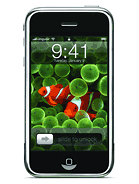
Apple iPhone Specifications


Network

Technology / Frequency Bands GSM : 850/900/1800/1900 MHz

Battery

Type Li - Ion
Capacity mAh
Standby 250 hours
Talktime 480 mins

Built

Dimensions 115x61x11.6 mm
Weight 135 g
Antenna Type Internal
Form Factor Unique
Colors Black
Touch Screen yes

Display

Size 320x480 pixels
Type color : TFT
Colors 16000000 colors
Secondary Display no

Camera / Imaging / Video

Camera Yes Inbuilt 2.0 Megapixel
Resolution 1600x1200 pixels
Resolutions Supported 1600x1200 pixels
Zoom no
Flash no
Secondary Camera no

Connectivity

Bluetooth Yes , version 2.0 + EDR
Irda No
Wlan/Wi-fi Yes Modes: 802.11b / 802.11g
Pc Sync no
SyncML no
USB yes
GPS no

Data

Data Modes GPRS / EDGE (EGPRS)
GPRS Yes
EDGE Yes
3G No
Internet Browsing , Safari

Media

Audio Playback Yes
Audio Formats MP3
Video Playback Yes
Video Formats MPEG-4
Ringtones
FM Radio No

Memory

Inbuilt 4 GB
Memory Slot No
PhoneBook

Messaging

SMS Yes
MMS Yes
Email Yes

Calling / Voice

Software

Java n/a
Games yes

iPhone 4 prices from around the world


Now that the iPhone 4 is available around most of the world, iFun designed this interesting little infographic that compares the various prices of the handset around the globe. Note that all of these prices are in Euros, and that they all reflect the out-of-contract price -- because the US iPhones are locked to the AT&T network currently, our country doesn't appear on this list.

But if you want to buy an unlocked iPhone elsewhere in the world, you should probably go with Hong Kong, where an unlocked 16gb phone will set you back US $653. Italy sells the costliest iPhones, with the price reaching up over US$1000 there for an unlocked phone.

This whole thing is really just more of a fun comparison rather than a really solid analysis -- most people who want an iPhone will probably buy it in the country where they live, especially if they need a certain contract. But it is interesting to see just where Apple has determined it can go higher on the price, either because of certain tariffs or shipping that must be paid, or just because the demographic calls for it.

Rabu, 09 Maret 2011

How Much Juice Will Apple Wring From iPad 2?

The iPad 2 hits the shelves Friday, and while it wouldn't be foolish to expect lines at your local Apple store, the magnitude of the device's improvements over the first model have met some skepticism. "While it was expected that Apple would improve on the iPad, it's questionable that the new device is worthy of being hailed as the second generation," Retrovo's Jennifer Jacobson said.Although Apple (Nasdaq: AAPL) is gearing up for another run on its stores Friday when the iPad 2 goes on sale, Cupertino is not without its reasons to worry.

The iPad 2 received mixed reviews when it was first revealed last week, and it's questionable whether the improvements made to the device will be enough to drive very strong sales. Further, there's speculation that application developers may have to rework their iPad apps to take advantage of the iPad 2's dual-core processor and improved graphics, a move which may send some into the Android camp.

Meanwhile, statistics show Android is taking first place in the United States mobile market; Google (Nasdaq: GOOG) is working to defragment the operating system and, perhaps, unify it in the long run; and Android is expected to lead the tablet market charge by 2014.

In what might be more bad news for Apple, the CDMA iPhone on Verizon Wireless appears to be suffering from the same death grip problem that plagued its cousin on the AT&T (NYSE: T) network. Also, Verizon is going to introduce tiered data plans, doing away with the all-you-can-eat approach it had earlier espoused in a bid to lure iPhone owners away from AT&T to its own network.
Click Here
Is the iPad Fizzling?

Since it was revealed last week, the iPad 2 has taken heat from critics who say it offers barely any technical improvements over its predecessor, with some pointing out that its multicore processor and improved graphics have only let it catch up to the Motorola (NYSE: MOT) Xoom, its main tablet rival that was launched days prior.

"While it was expected that Apple would improve on the iPad, it's questionable that the new device is worthy of being hailed as the second generation," Jennifer Jacobson, public relations director at Retrovo, told MacNewsWorld.

"Given that there weren't any groundbreaking feature upgrades, the new device resembles an iPad 1.5," Jacobson added.

Perhaps Apple Chairman and CEO Steve Jobs anticipated this reaction when he stated at the iPad 2's unveiling that you need to combine technology with the liberal arts and the humanities. In other words, the iPad 2 isn't much more technologically advanced, but it's kinder, gentler and more humane.

So, is the iPad 2 dead in the water? Will it not contribute as much to Apple's revenues as expected?

Piper Jaffray analyst Gene Munster reportedly issued a note to investors predicting that 5.5 million units of the device, which will be available nationwide Friday, will be sold this quarter. This is followed by waffle about "factors like online pre-orders, weather, timing in the day and the day of the week" all possibly impacting a consumer's willingness to stand in line.

But those considerations didn't seem to apply when Apple launched the iPhone 3GS, the iPhone 4 on AT&T's network or the first iPad.

Barclays Capital contends the iPad 2 will keep Apple in the lead. Gleacher analyst Brian Marshall has reiterated his "buy" rating on Apple and pegged his price target at US$400 a share, although his note to investors focused on the iPad Smart Cover Apple is offering.

However, RBC Capital analyst Mike Abramsky has reportedly predicted that 40 percent of tablets sold in 2014 will run Android. Considering that Apple has more than 90 percent of the market now, that's a considerable slide.
Reworking iPad Apps

There's some concern among app devs that they may have to rework their existing wares to make the best use of the iPad 2's dual-core processor and improved graphics. However, that may not be as big a problem as feared, Brian Meehan, vice president for sales at Sourcebits, told MacNewsWorld.

"Software development kits are always being updated," Meehan pointed out. "Existing applications should be updated, not rewritten, to take advantage of the new features of the iPad 2."
Android's Threat Increases

Meanwhile, Apple's coming under more pressure from Android.

Android leapt to first place in the U.S. mobile market in January, comScore has announced. Android had 31.2 percent of the market, second placer RIM had 30.4 percent, and Apple was in third place with 24.7 percent.

Further, Google recently released the Fragment API in Honeycomb, aka Android 3.0. This is aimed at curbing the fragmentation of the Android OS.

In addition, Google has announced that it'll include some of the features of Honeycomb, its version of Android for tablets, in the next version of Android for smartphones.

Eventually, Google may combine the two and offer one mobile operating system for a variety of mobile devices.
Verizon Vexations

Finally, the iPhone's expansion to Verizon's network may not be going flawlessly.

The CDMA iPhone 4 has suffers from the same deathgrip problem that plagued the GSM version on AT&T's network last year, according to Consumer Reports, though AnandTech's Anand Shimpi claims the problem's been fixed.

Furthermore, after examining a study from mobile analysis firm Metrico, Wired concluded that the Verizon iPhone's download speeds are actually slower than those of the AT&T model.

Add to that the news that Verizon is going to do away with its unlimited data network plan for CDMA iPhone users and use a tiered approach instead, and it might not be wrong to conclude that Apple needs to find another way to get more revenue.

Apple share prices closed Tuesday at $355.76, up 40 cents in active trading, further signaling investors' skittishness in a market that picked up overall, with the Dow Jones, NASDAQ and S&P 500 registering gains and gold down a tad.

Senin, 28 Februari 2011

Apple's March Madness: In Like a Lion

Apple kicked off what looks to be a few weeks of big news by putting a new line of MacBook Pros on the shelves as well as giving developers a new OS X Lion preview. News about iPad 2 and iOS 4.3 is expected soon. Meanwhile, a WinPho 7 update snuffed some phones, Amazon ruffled Netflix's feathers and Apple's board scuffled with investors.If you nauseate easily at the prospect of non-stop Apple (Nasdaq: AAPL) announcements, right now might be a good time to take a long hike in the woods, weather permitting. Apple's given developers a brand-new preview of OS X Lion; next week we'll see an announcement that's almost certainly going to be all about iPad 2; and there are rumors that iOS 4.3 is just around the corner.

Previews and just-about-there hearsay aside, Apple also pulled off an actual product release this week. A new batch of MacBook Pros washed ashore, and in terms of design, they're really very similar to last year's models. There were a few notable steps forward, though, including a new technology Intel (Nasdaq: INTC) has been talking up over the last few months.

But first, processors: All three models -- 13, 15 and 17 inches -- have Intel's latest Core processors, and the bigger two offer quad-core options. In graphics, the larger models have ditched Nvidia (Nasdaq: NVDA) and jumped over to AMD's (NYSE: AMD) camp.

Apple's also polished up the webcam to provide 720p HD video-calling abilities. You can use FaceTime, too, if you happen to have an extra dollar.

Then there's Thunderbolt, the new input/output system built on Intel's Light Peak technology. It's all about fast data transfer speeds -- up to 10 gigabits per second. So you can move lots of data into and out of the computer -- as long as that other data bucket happens to be have a Thunderbolt port as well. Several companies say they have stuff on the way, but it's going to be a while before you'll find it everywhere you turn.Everyone's Gone to the Movies

There are two kinds of Amazon (Nasdaq: AMZN) Prime members: 1) People who buy lots of stuff on Amazon and figure they probably save money by paying a flat $79 per year to get free express shipping on anything, any time; and 2) People who signed up for a free one-month membership in order to save a few bucks shipping one item, then forgot to cancel the automatic renewal.

But Amazon's Prime membership isn't just about shipping; the latest perk the retailer's given its VIPs is movie streaming. Anyone familiar with Netflix's (Nasdaq: NFLX) system should recognize how it works: Choose the night's entertainment from a catalog of thousands of movies and TV shows, then just sit back and watch, commercial-free, either through a computer or any of the various set-top boxes that already work with Amazon's video download service. No limits as far as Amazon's concerned, though your ISP might have a different theory about that.

Amazon's providing this at no extra charge above the annual fee Prime members already pay. And it just so happens that the fee actually comes out to a few bucks less than what Netflix charges for 12 months of its own streaming-only plan.

But you can't call Amazon's offering just flat-out better than Netflix's, not yet anyway. For one thing, Amazon's streaming library is about 5,000 titles strong; the Netflix instant catalog is about five times that amount. Also, there's no sign Amazon is about to budge from its annual membership system and open up some kind of pay-by-the-month offering. Maybe they figure they'd get too many hop-ons. So after that first free month, new users will have to commit for a full year.

Finally, Amazon currently offers no way to stream video directly to a mobile device through an app. Netflix, on the other hand, has an iOS app -- though that's exactly the kind of app that seems like it could quickly suffocate if Apple intends to enforce its new subscription rules across the board, not just for magazines and newspapers.
Fail Deadly

Microsoft's (Nasdaq: MSFT) plans to keep a foot in the mobile game with Windows Phone 7 are well under way, and it even has the massive, hulking Nokia (NYSE: NOK) on its side. But in terms of basic mobile OS childhood development, WinPho 7 has a few skills it still needs to acquire in order to catch up with the rest of the class.

One of these is copy and paste. Might not be a feature everyone uses all the time, but it's sort of the technological equivalent of being able to dress and feed yourself -- if you don't know how to do it, the perception is that you're definitely behind the curve.

Perhaps copy and paste were what a lot of Windows Phone 7 users were hoping for when they started installing the OS's latest update this week. It's not what they got, though -- this update seemed to be focused on improving the update process. A meta-update, or something.

And that's if the whole exercise worked properly. But as some owners of Samsung Windows Phones soon learned, the process was not universally smooth. Some reported that it kept freezing up mid-stride, and in certain cases, it more or less bricked their phones -- in other words, scrambled their firmware so bad they were rendered inoperable. Microsoft quickly pulled the update from Samsung models.

Some feel that Microsoft really ought to graduate to a system that does over-the-air updates, where you don't have to plug your phone into a computer in order to get the latest version of the OS. That might have its advantages from a convenience perspective, but if the software's botched to begin with, it doesn't matter what the phone is or is not plugged into; its brains are still gonna get scrambled.

Over-the-air is no guarantee against defective updates. I remember that last summer, Sprint's (NYSE: S) EVO 4G, an Android phone from HTC, had its own little problem with a bum update, and that one was done over-the-air. If you have to plug it in, at least you might have a chance to back up and create a restore point -- if the management software's designed that way.
It'll Probably Come Down to a Game of Snooker

Much doubt has been raised about Apple CEO Steve Jobs' role at the company right now. Technically he's on a leave of absence, putting COO Tim Cook in charge. Tabloids report his health issues have taken a turn for the worse. Yet he's said to be calling Apple's major shots from home, he was well enough to join a who's-who-in-technology dinner with President Obama last week, and those cryptic, one-liner responses to random emails from the public are still trickling in every now and then.

Just like the last time Steve Jobs had to take a major break from full-time duties, his absence has made some shareholders very anxious. They want to know what the board's plan is for when Jobs isn't in charge anymore, whether that happens tomorrow or many years from now. Will Cook officially take over immediately, or will the job be open to applicants? Will it only consider current top Apple execs, or will there be some outside head-hunting? Or will it reorganize into some kind of new-agey council of elders where no one person officially wears the turtleneck?

Apple's board says it does indeed have a plan, and it's not difficult to believe that's true. Not having any kind of plan at all would be so fiscally irresponsible that it makes me wonder whether someone might end up in jail over it. So the board knows what it'll do; it just doesn't want to talk about it publicly.

Not all shareholders agree with that strategy, though, and the issue came to a head this week at a shareholder meeting in which the board squared off with the Laborers' International Union of America, backed by Institutional Shareholder Services. LIUNA wants that succession plan publicly known, and it put it up for a shareholder vote.

Apple's board is thoroughly against this; it maintains that disclosing its plan would hurt its ability to recruit and retain top executives. Those who see that they're clearly nowhere near on the right track to the crown might be less inclined to work with Apple. Apparently that's what most shareholders think too; preliminary results indicate the board won the standoff.

Not exactly surprising -- Apple's one of the most secretive publicly traded companies on Earth. It's also been one of the most successful over the past decade or so. Hard to say whether that's because of all the secrecy or in spite of it, but it seems most Apple shareholders are happy enough with its performance that they'll allow the board to keep yet another secret tucked away if that's what it thinks is best.
Metabolic Frolic

You always hear about how much tougher previous generations were, how they worked harder and put up without the comforts we take for granted today. But I say the people who are alive today are pretty tough too, in our own way. We gobble up fish saturated with mercury, we breathe air full of toxic exhaust fumes, we walk around under a depleted ozone layer, and a lot of our food is so heavily processed it would hardly be recognizable to someone from 200 years ago. Yet our life expectancy is still greater than it was back when it was all blue skies and clean living. Progress!

We can even take a radiological kick to the head without even blinking, which is kind of what happens every time you use a cellphone. The thing making it work is a microwave radio that uses the same frequency as a microwave oven, and although it probably won't boil your brain matter in two minutes, it still does a little something to your gray goo, according to recent research. What that something is, and whether it's good, bad or indifferent, is still unclear.

For the study, researchers pumped 47 people with a fluid used to measure brain glucose metabolism, then strapped phones to their ears and let 'em rip for about an hour. Then they monitored them for the same amount of time with the phones turned off.

What they found was that metabolism in the brain region closest to the antenna was 7 percent higher when the phone was on. They said that suggests the human brain is indeed sensitive to the kind of radiation cellphones put out.

What's more difficult to figure out is exactly how harmful that is, if at all. It might be more dangerous to younger people whose brains are still developing, and adults with neurological problems or brain injuries. But the technology's still too new to know the full life-long affects of cellphone use, if any.

It's been a quarter century since Gordon Gecko wowed the world with his fruitcake-sized Motorola (NYSE: MOT), but it'll be at least that much longer before we'll know exactly what happens to a human brain after using a cellphone daily from adolescence well into adulthood.

Sabtu, 26 Februari 2011

Lion Scopes Out Territory in Apple Ecosystem

Apple's newest iteration of OS X, Lion, includes some features inspired by iOS, the system designed specifically for the iPhone and iPad. Like iOS, Lion comes with an app store built in. One burning question is whether Apple will make an effort to corral most -- if not all -- of the software developed for OS X and make it available only through the Mac App Store, a move that would most likely be viewed as too controlling -- even for Apple.Apple (Nasdaq: AAPL) may be hoping that Mac operating system release number eight becomes the eighth wonder of the technological world. The company released a developers preview of the OS, code-named "Lion," on Thursday.

However, Lion is primarily a "user interface evolution rather than a back-end functionality upgrade," according to Appitalism founder and CEO Simon Buckingham. Mac OS X Lion features Mission Control, a new Mac view; Launchpad, a new app home; full screen apps that use the entire Mac display; and of course, the new Mac App Store.

Mission Control provides a "bird's eye view of every app and window running on your Mac," said Apple representative Monica Sarkar. "Launchpad makes it easier than ever to find and launch any app. Multi-touch gestures give you a natural and intuitive way to interact, like pinching your fingers to zoom in and swiping left or right to turn a page."

Mac OS X Lion - Mission Control
iPad Inspiration

With the wild popularity of its iHandhelds -- iPad, iPhone and iPod -- it's no wonder Apple is incorporating a slew of iOS features into OS X.

"The iPad has inspired a new generation of innovative features in Lion," said Philip Schiller, Apple's senior vice president of worldwide product marketing.

Those features come with a dizzying array of trademarked monikers. "Conversations" automatically groups related messages into a single timeline. "AirDrop" copies files wirelessly from one Mac to another.

"Versions" automatically saves successive versions of a document, with additional browse, edit and revert options. "Resume" brings apps back exactly as they were left on quit or restart. And "FileVault" provides disk encryption for local and external drives, along with the ability to wipe data instantaneously.

"I suspect all these new features hint at an accelerated announcement pace," Appitalism's Buckingham told MacNewsWorld. "Apple will probably move to twice yearly OS and iOS updates so that Android doesn't catch up to them."
App Store Roar

The new Lion features could hint at tighter controls over Mac software -- even more restrictive, perhaps, than those that apply to the iOS App Store.

Still, Lion and Apple iDevices are different animals, said Herbert Tsang, Ph.D., a bioinformatics researcher and instructor at the Simon Fraser University School of Computing Science.

"Through the App Store, the tight control that Apple has over their iDevices software is notorious," Tsang told MacNewsWorld. "There is no indication, however, that the [Mac] App Store will be the only way to obtain Mac software."

Mac OS X Lion - Mac App Store

A Lion roaming in Apple's pristine ecosystem might also suggest that even higher walls are on the way. However, the act of building those walls would likely leave clues, "such as making iOS apps seamlessly available on the Mac platform, which is what I'd be looking for if I thought Lion involved issues of increasing control," Appitalism's Buckingham told TechNewsWorld. "I don't see any of that, however."

In fact, coupling the Mac App Store too tightly and seamlessly to the Mac would be a "step backward" in the progress of technology, SFU's Tsang remarked.

Simply having an app store available on a Mac, however, "is a way for individual developers to sell their software and will be a great benefit," he said. "The new integration ... in Mac OS X Lion is a way to benefit individual software developers. It is an effort to offer alternatives, rather than exclusivities.

Apple speeds up MacBook Pro

Apple on Thursday morning unveiled a new line of high-end laptop computers that's about twice as fast as the older generation, according to the company.

The MacBook Pro laptops get a speed boost from faster Intel processors, which can reach "Turbo Boost" speeds of 3.4 gigahertz. In nongeek speak, that means the computers can complete 3.4 billion calculations per second.

Apple says it's using the "fastest dual-core processor available."

The laptops also are the first computers to feature Intel and Apple's "Thunderbolt" technology, which is a new way to connect cameras, camcorders and the link to the computer -- an alternative to USB ports, which are ubiquitous today.

Apple says these new ports are much faster than existing alternatives.

"Ultrafast and ultraflexible, the Thunderbolt pipeline is more than 12 times faster than FireWire 800 and up to 20 times faster than USB 2.0, and it offers unprecedented expansion capabilities. It changes what you can do on a notebook," Apple says in its advertising materials.

The new laptops also have USB and FireWire connections.

The MacBook Pro computers -- some of the most expensive laptops on the market -- start at $1,200 for a 13-inch model and go up to $2,500 for a computer with a 17-inch screen, when measured diagonally.

The computers come with Intel's Core i5 and Core i7 dual-core processors. Their speeds range from 2.0 to 2.7 gigahertz but can jump to 3.4 gigahertz, the company says. Apple claims these processors make the new MacBook Pro twice as fast at processing data and three times as fast at rendering images.

Another new feature of the laptops -- which, from photos, look almost identical to their predecessors -- is the addition of a FaceTime video camera. This will allow MacBook Pro users to conduct video chats with people on mobile phones and iPods that support Apple's FaceTime video chat app, which is similar to Skype. Previously, iPhone 4 FaceTime users could only chat with each other -- not with people who were using laptops.

"FaceTime for Mac makes it easy to talk, smile and laugh with friends and family on their iPhone 4, iPod touch or Mac," Apple says in an ad for its FaceTime app for the Mac, which costs 99 cents.

Some Apple fans were initially disappointed by the specs of the new laptops.

"I have to say it looks like they just wanted to get this out of the way and move on to the actual main event, the iPad 2. iPad is the future," one commenter wrote on the blog Apple Insider.

Another complained that Apple updated the MacBook Pro series instead of the MacBook Air, which is a lighter laptop that boots up instantly.

"I'm sure many will be thrilled by the speed, but I'm majorly disappointed. ... My hopes for a MacBook Pro Air have been dashed.... Maybe next year ...," another commenter on that blog wrote.

Others weren't wowed by the computers' screen resolution.

"Reeeaaallly disappointed with the 1280x800 resolution? Why??" wrote a commenter on The Unofficial Apple Weblog, or TUAW.

Jumat, 25 Februari 2011

Roll of Distant Thunder Ushers In New MacBook Pros

Apple has released a new line of MacBook Pros with faster processors, sharper webcams and a new I/O technology called "Thunderbolt," based on Intel's Light Peak. It facilitates super-fast data transfers -- up to 10Gbps. While a few Thunderbolt-ready accessories are in the works, it may be some time before the technology is truly ubiquitous.Optimize software licensing, boost cyber security. Click for white paper & demo.

Apple (Nasdaq: AAPL) on Thursday announced four new MacBook Pros with next-generation processors and graphics; high-speed Thunderbolt input/output technology; and new FaceTime HD cameras.

MacBook Pros
Apple's 13-inch, 15-inch and 17-inch MacBook Pros

These run on the latest dual- and quad-core Intel (Nasdaq: INTC) Core processors and are claimed to be up to twice as fast as their predecessors.

Thunderbolt is a technology Apple codeveloped with Intel, which calls it "Light Peak."

Apple also released the developer preview of Mac OS X Lion Thursday. This includes features from the iPad's iOS operating system.

The initial reception for the new MacBook Pros may not have been as warm as Apple expected.

"I can't see anything that's really that revolutionary except maybe Thunderbolt," Jim McGregor, chief technology strategist at In-Stat, told MacNewsWorld. "The newest version of their operating system is really the most interesting thing," he added.

"Thunderbolt will handle multiple DisplayPorts, and that's big news for analysts who need to look at lots of data at once," Carl Howe, director of anywhere consumer research at the Yankee Group, told MacNewsWorld.

Apple did not respond to requests for comment by press time.
Reading the MacBook Pro Specs

There are three new MacBook Pros, with screen sizes of 13, 15 and 17 inches.

The 13-inch version features either a dual-core Intel Core i5 or i7 processor with a speed of up to 2.7 GHz. It also has an Intel HD Graphics 3000 processor.

The 15- and 17-inch models have quad-core Intel Core i7 processors rated at up to 2.3 GHz. Apple's spreading the love with graphics processors, using the AMD (NYSE: AMD) Radeon HD graphics processors with up to 1GB of video memory in these larger MacBook Pros.

"More cores are good for battery life," Howe stated.

All three models of the new MacBook Pros will include a built-in FaceTime HD camera with triple the resolution of the previous generation of the camera, Apple said. This allows HD video calling between all new MacBook Pro models. It supports standard resolution video calls to other Intel-based Macs, the iPhone 4 and the current-generation iPod touch.

However, Apple didn't state whether it was referring to the GSM version of the iPhone 4, offered by AT&T (NYSE: T); the CDMA version, which is from Verizon Wireless; or both.

All three MacBook Pros will have aluminum unibody enclosures, glass multitouch trackpads, LED backlit widescreen displays, illuminated full-size keyboards, and batteries offering 7 hours of life between charges, depending on how the laptops are used.

Pricing for the 13-inch MacBook Pro will begin at US$1,200. The 15-inch MacBook Pro will start at $1,800 and the 17-inch version at $2,200.

Optional add-ons include faster quad-processors, additional hard drive capacity, solid-state storage up to 512GB, up to 8GB of DDR3 memory, and 'antiglare and high-resolution displays, Apple said.
Releasing the Thunderbolt

The new MacBook Pros also include Thunderbolt I/O technology codeveloped by Apple and Intel.

This features two bidirectional channels with transfer speeds at up to 10Gbps (gigabits per second) each.

Thunderbolt uses two protocols -- PCI Express for data transfer and DisplayPort for displays. It is compatible with existing DisplayPort displays and adapters, Intel said. All Thunderbolt technology devices share a common connector and let users daisy-chain up to six peripherals with electrical or optical cables.

Thunderbolt delivers PCI Express directly to external high-performance peripherals such as RAID arrays. It can support FireWire and USB consumer devices and gigabit-speed Ethernet networks through adapters, Apple stated.

"The storage guys would be happy; imagine what NAS [network-attached storage] guys could do with data transfer speeds like this," In-Stat's McGregor remarked. "But this applies more to corporate than consumer solutions."

Thunderbolt technology requires an Intel controller chip and a small connector for mobile devices that will be included in products supporting the technology. The controller chip provides protocol switching capabilities to support PCI Express and DisplayPort over a single cable.

Avid, Blackmagic, LaCie, Western Digital (NYSE: WDC) and Apogee are among the companies that have either announced products based on Thunderbolt technology or plan to support the technology in future devices, Intel stated.
Is Thunderbolt Ready for Prime Time?

Intel hasn't quite lived up to its promise of making Thunderbolt an optical technology. At the Consumer Electronics Show, held in Las Vegas January, Intel executive David Perlmutter said that the initial builds will be based on copper.

Copper's good enough for the majority of user needs today, Perlmutter said.

However, copper wires limit the speed and range of data transmission.

"Intel's whole thing with Light Peak is to enable optical interconnections, because you get over lots of limitations in terms of speed and distance imposed by copper," In-Stat's McGregor pointed out.

However, connectivity is going to be a problem for some time, McGregor warned.

"Nobody has external PCI Express ports on their PCs, or any peripherals that will connect to Light Peak," McGregor said. "How long is it going to be before your PC and TV and your peripherals support Light Peak? It might be years."

Although Intel's Perlmutter struck a conciliatory note when talking about Light Peak at CES -- he said it could coexist with USB 3.0 and run USB, display and networking protocols on top of it -- Apple took a more combative stance.

Thunderbolt technology is expected to be widely adopted as a new standard for high-performance I/O, Apple said when announcing the new line of MacBook Pros.

Intel did not respond to requests for comment by press time.

Rabu, 23 Februari 2011

Obama at dinner with Steve Jobs and Mark Zuckerberg

A photo released by the White House on Friday shows Apple CEO Steve Jobs, along with other tech luminaries, raising a toast with President Barack Obama at a dinner Thursday night in San Francisco.

The photo, of a private dinner during the President's visit to California, comes as tabloid reports, some featuring alleged photos of Jobs, have questioned the Apple leader's health.

In the photo, Jobs and Facebook CEO Mark Zuckerberg flank Obama during the toast. Wearing his trademark black mock turtleneck shirt, Jobs is photographed from behind.

Jobs was diagnosed with cancer in 2003. He took a six-month leave of absence in 2009, during which he was reported to have had a liver transplant.

He began an indefinite medical leave of absence on January 17.

This week, a supermarket tabloid and a gossip website ran unconfirmed reports suggesting that his health was declining.

Neither Apple nor Jobs, or anyone directly familiar with his health care, have commented publicly on the reason for his leave or the most recent rumors.

Jobs had kept a low profile since unveiling a new line of MacBook laptops in October.

Obama's meeting with the tech luminaries was intended to discuss innovation and spurring job growth.

Also worth noting: Zuckerberg appears to have shed his go-to hooded sweatshirt look for his dinner with the leader of the free world.

Others attending the dinner included Google CEO Eric Schmidt, Yahoo! CEO Carol Bartz, Twitter CEO Dick Costolo, Cisco Systems CEO John Chambers, Oracle CEO Larry Ellison and Netflix CEO Reed Hastings.

Also, Stanford University President John Hennessy, Genentech CEO Art Levinson, Steve Westly, founder of The Westly Group and John Doerr, a partner at Kleiner Perkins Caufield & Byers