Tampilkan postingan dengan label life style. Tampilkan semua postingan

Sabtu, 12 Maret 2011

Changes the Game with Low Cost High End Android Phone

Android phones come in two flavors: high-end and low-end. High-end phones usually end up with a price tag between US$500 and US$600 off-contract. If you want them cheaper you can generally get them subsidized when you contract with your carrier for two years. Generally that brings your price down to the US$150 to US$250 range.

Low-end phones can be had for around half the price of their high-end siblings.

On the larger carriers, that two year contract generally includes signing up for a data plan, which is likely going to cost you around US$50 to US$70 per month, plus voice, plus text, plus some "privilege of being their customer" fees.

Cricket, on the other hand, is a different kind of carrier. They don't force you into a contract, and they have a flat monthly cost. The catch? The phones aren't subsidized and the coverage isn't as broad as the larger carriers.

Regarding the phones, generally Cricket phones have been regarded as "cheap". They get the job done, but that's it. Why? People don't generally want to fork out a big chunk of change when they sign up for a phone -- apparently they'd rather have much more than that squeezed out of them over time.

What does this have to do with Android? According to Market Watch, Cricket is changing the game with their newly announced phone, powered by Android.

The phone in question is the Huawei Ascend, which is being touted as "the first low-cost Android device to hit the Smartphone market in the United States".

The Ascend will be available in mid-October for around US$149.99. That doesn't sound all that great until you realize that it's off-contract. You don't have to commit two years of your life to a carrier that you may end up hating. You're free to leave at any time. Additionally, your monthly bill will be astoundingly low: US$55, which gives you unlimited talk, text, 411 information, navigation, and unlimited 3G data.

The Ascend sports a 3.5" HVGA touch-screen, WiFi, 3.2MP camera, and runs on Android 2.1.

Kamis, 24 Februari 2011

What Can 3D Do for the Web?

Electronics manufacturers are still trying to pull together the right mix of conditions necessary to make 3D TV reach critical mass in consumer popularity -- price, content, standards, etc. Could the Web be an easier channel through which 3D can blossom? It may be easier to distribute content, but hardware runs into a familiar chicken-and-egg problem.In 2009, director James Cameron made people love seeing 3D movies in the theater again. In 2010, electronics companies began offering the first in-home stereoscopic 3D TV sets, and content providers launched Blu-ray 3D and broadcast 3D channels.

Now it's 2011, and there are still big changes happening in the 3D space, but there's one major source of media and entertainment that hasn't really come a-knocking to the 3D door yet.

It's surely only a matter of time before the Web starts going to a new dimension.
Early 3D Troubles

Despite all of the 3D stuff going on in the consumer electronics market these days, advances may be coming a little too fast for some consumers. 3D TV sales Increase sales with VerticalResponse. Free trial. last year were below expectations for manufacturers like Samsung, which threw considerable weight behind the new format. Many consumers shied away from this expensive new format that had almost no content.

Despite that, many are starting to take a different path. One of the emerging trends is glasses-free 3D technology, also known as "autostereoscopic 3D." LG has introduced a new iPad rival, the G-Slate, which can produce images that have the sense of depth, without the need for users to wear glasses. But something like that can only have high appeal if there is compelling content.

Obviously, 3D TV programming and Blu-ray 3D movies are out of the question there, so 3D content on the Internet would perhaps be the most compelling selling point.

Aside from glasses-free 3D tablets, computer makers that are manufacturing 3D hardware are finding it difficult to advertise exclusive 3D content. 3D computers are selling even worse than 3D TVs. At this point, it's up to online Create an online store today -- 30 day free trial. Click here to learn more. content providers to step up to the plate and bring this home media revolution to the cyber world.
Adding 3D to the Web

This isn't a completely new idea. There have been limited 3D streaming events online. NASCAR helped bring some of its races last year to 3D computer viewers via an exclusive online stream that was not broadcast on any 3D TV network. For the most part, though, 3D hasn't penetrated the Net.

It's a tough game of catch-22, Jordan Cressman, associate professor at The Ohio State University and a blogger for I4U News, told TechNewsWorld.

"Internet content providers don't want to spend resources creating 3D content unless there are a lot of people with Internet-connected 3D devices," she noted. "But by the same token, people don't want to buy expensive 3D devices unless there's a lot of 3D content."

Realistically, Cressman said, it's the content providers who need to make the first move. However, that might be an easier proposition for the Internet than it is for a traditional movie studio or satellite provider. Current 3D pioneers like DirecTV (Nasdaq: DTV) and ESPN have had to not only buy new 3D video equipment and transmission technologies, but they have to lobby advertisers to make 3D commercials and help manufacturers market their 3D hardware.
It's Not As Easy As It Sounds

For an Internet company, the only thing required is content. Distribution is easy, as Forrester analyst Josh Bernoff pointed out.

"The technology is there. Adobe (Nasdaq: ADBE) and Roxio have 3D video software, and there are already affordable 3D cameras on the market," Bernoff told TechNewsWorld. However, he said, there is still a hurdle with getting consumers to buy the hardware. "Sluggish sales of 3D TVs are sending a clear message that consumers don't really want 3D content in their homes, at least not yet."

That could be the message, or it could just be that consumers are confused by the whole 3D technology revolution. After all, there are a lot of things to consider when getting a 3D setup. It's not as easy as when the HD shift happened -- back then, consumers needed to buy an HDTV and an appropriate set of cables.

Now, they have to buy a 3D TV and 3D glasses that are made by the same manufacturer as the TV -- that is, if you buy a stereoscopic 3D TV. However, if you buy a Cinema 3D TV, like the one currently available from Vizio, you can buy any set of passive 3D glasses. Then again, there are new 3D TVs coming out that don't require any glasses. And to watch a Blu-ray 3D movie, you can't use any old Blu-ray player; you need one that specifically has 3D functionality.

Unfortunately, that same confusion applies to computers as well, with some displays that require 3D glasses and some that don't.

Also, many consumers have eye conditions that simply don't allow them to see 3D effects at all.

"Before launching, did [3D TV manufacturers] know that the thing can actually make roughly 20 percent of the audience sick to their stomachs? Did they take into account that an overwhelming majority of consumers say they are not interested in 3D TV? Or, at least, paying premium prices to bring one home?" said TVPredictions.com President Phillip Swann.

"If TV makers don't slow this train down, 3D TV could become the biggest -- and most costly -- mistake in the history of consumer electronics," he told TechNewsWorld.
Too Big to Fail?

In the end, it may be this variety of formats that kills 3D, but no one seems to want to stop trying. 3D is not a fad, Cressman contended, but merely a format experiencing growing pangs.

"There are a lot of problems with 3D in the marketplace, but with the entire consumer electronics and content industries in extreme support of it, there's no way it will die," she said.

Rabu, 23 Februari 2011

Copia – social media meets the eReader

If we need evidence of the central role the digital world is taking in our modern lives, we need look no further than social networking. In a very short time, updating Facebook profiles and Tweet streams have become a pivotal part of everyday life for many millions of people. Even our literary preferences are beginning to lean more towards the digital, with Amazon recently announcing that the sale of digitized books had overtaken the sale of printed versions. The Copia platform brings both of these activities together in one place, offering members a new way discover, share and purchase books, newspapers and magazines.In addition to providing an online bookstore, the Copia platform allows members to annotate, highlight, make notes or otherwise draw attention to passages of particular relevance or importance in books they are reading. Those can then be shared with friends, family and colleagues via linked social networking profiles – like Twitter, Facebook and LinkedIn – or to the wider Copia Community.

Users can comment on entries made by other users, making books that can then exist as both an original work and as an annotated, highlighted and commented shared experience. Unlike other collaborative e-Reading approaches, the Copia platform also allows anyone who prefers to read paper versions of books to join in with community discussions.
The Copia tailors the search for content towards providing a real-world experience, with members being able to search for content based on user ratings, tags, popularity, price, genre and so on. Results are displayed on a dynamic content page, which is said to offer users the chance to compare lots of titles in one place.

The layout offers toggling between list and expanded views, with the latter showing reader ratings and reviews to help users make a more informed reading choice. Members can also join or create virtual book clubs to further discuss content with those who share common interests.

Students might find the collaborative note-sharing particularly useful, giving them the chance to remotely work on a project with others, or allowing tutors to add notes and highlight relevant passages for all the class to see. The Copia also allows authors to interact directly with their readers through community discussions or by making their notes and thoughts available.

Developers can benefit from the Copia platform via an integrated software application engine which allows them to deliver content across the numerous digital media readers currently available.

The Copia device agnostic, social media and content delivery platform is available now.

Selasa, 22 Februari 2011

Google Chrome 10 beta Performance

Google has just released Chrome 10 beta (10.0.648.82 for all you perfectionists) and it brings with it a whole slew of new things to play with.First off, there’s a significant JavaScript performance boost thanks to the updated V8 engine. According to Google, this version of the V8 engine offers a 66% performance advantage over the current stable release. That alone is pretty impressive.This beta also adds GPU acceleration for video. For those running video in full-screen mode this can mean a decrease in CPU usage of as much as 80%. A good thing for those living off battery.

Another new feature is that the browser setting page now opens in a tab of its own rather than in a separate window. A small change but one that makes a lot of sense. There’s also a handy search box to allow you to find the specific setting you are looking for. Might not be needed by geeks, but dead handy for everyone else (Hey, Microsoft! Here’s a setting that would be really handy for IE users … fire up those photocopiers!).

Syncing now includes saved passwords, along with bookmarks, preferences, themes and extensions. Synced passwords can be encrypted with a separate passphrase.


AvastFreeAntiVirus5=

e-wallets car in mobile phone

BARCELONA, Spain--Later this year you'll be able to pay for clothes, taxi fare, and dinner with your mobile phone and leave your credit cards and cash at home.

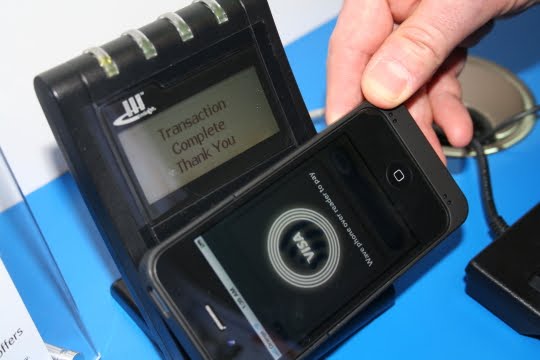
Visa is planning a commercial rollout in the U.S. in the second half of this year of a service for allowing allow people to turn their existing smartphones into electronic wallets. It uses Near Field Communication (NFC) short-range wireless technology and includes real-time anti-fraud alerts and other features designed to protect consumers from fraud, Bill Gajda, global head of Visa Mobile, told CNET in an interview at Mobile World Congress 2011 here this week. Visa was demonstrating its PayWave mobile payment system at the show.

Despite the promise of convenience and ease of use, the e-wallet industry has gotten off to a sluggish start as mobile handset makers have dragged their feet on adopting NFC technology and retailers saw no need to install mobile payment readers if the phones weren't yet equipped. In 2008, the GSMA, a trade association representing the Global System for Mobile Communications industry, called on manufacturers to embed NFC chips in phones by late 2009 and three years later they are trickling out.

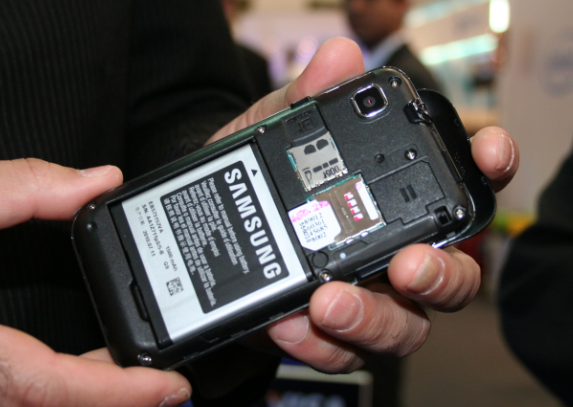
Rather than wait, Visa is offering a way to use existing smartphones by inserting a microSD (Secure Digital) removable memory card into the SD slots in the back of phones and, for the iPhone, in a special plastic skin. The card works in conjunction with Visa's PayWave downloadable app. Wells Fargo, Chase, U.S. Bank, and Bank of America have trials going with the technology in the U.S. (Another interim solution has been stickers affixed to mobile devices that allow for payments.)

"People don't want to wait two years for NFC-enabled phones to come out or to switch phones," to get one with an NFC chip sooner, Gajda said. "You can make payments today on the iPhone 4."

The terminal reader device is based on standardized technology so that it can work with Visa's PayWave system as well as MasterCard's PayPass and Express Pay from American Express. At this time, only Visa is offering an external memory card solution so phones that don't have NFC chips yet can be used--which is key to jumpstarting user adoption, according to Gajda.

"NFC technology will take off in 2011," he predicted. "The move from leather wallets to mobile wallets will come this year."

In trials, people are using their smartphones to pay fares in 10,000 taxi cabs and CVS stores in New York City and McDonalds and Whole Foods in San Francisco, and to ride public transit in New York and Los Angeles. (Search for cities and participating merchants here.)

Mobile payments are being made on iPhone 3 and 4, various BlackBerry models, and Samsung's Android-based Galaxy S II (displayed at Mobile World Congress 2011). NFC chips also could make their way into Windows-based phones made by Nokia, according to the NFC Times.

Google added some NFC capabilities to Android in an update earlier this year and reportedly is working on a mobile wallet code-named "Cream" that will be integrated into NFC-enabled Androids, while the Nexus S has NFC technology but does not support payments.

Meanwhile, Apple is rumored to be looking into adding NFC chips to a future version of the iPhone, according to reports.

NFC mobile payment systems have made some inroads in other countries, primarily Japan and Korea, while Brazil, India, and other countries will be adopting them over the next few years, Gajda said. Visa Europe has an SDcard solution trial for iPhone users in Turkey and is launching it in Europe too.

"We see contactless (mobile payments) as a leapfrog technology for many parts of the world," Gajda said.

With PayWave, the mobile payments can be charged to a user's credit card or debited from a bank account or a pre-paid account. Banks and retailers can also deliver coupons and other products and services to users via the system.

Here's how it works. A bank or other financial institution will distribute the microSD cards to customers who install them in an SD slot in the back of the phone under the cover. The customers then download the PayWave app to their smartphones.

When the customers see a terminal reader that accepts mobile payments, they open the app and click a button to start a transaction. On the iPhone, a swipe of a finger on a slider button activates the radio antenna. The customers then position the back of the phone directly in front of the reader to complete the transaction.

Safer than plastic?
But is it any safer than using a plain old credit card? Yes, Visa and others say. Anyone can swipe a credit card or steal the credit card number off a charge slip. Credit cards can also be cloned and skimming devices and videocameras hidden in ATMs and gas station terminals can snatch both the credit card number and the PIN.

The PayWave system has a number of features to protect against fraud and abuse. For instance, the system monitors activity in real time and can alert a customer within minutes of a suspicious transaction. It looks for anomalies in account activity and analyzes transaction size, merchant, and other information and then compares that with prior account activity and other transactions taking place on the Visa network.

The NFC chip has a secure component that generates a unique authentication code for each transaction, whereas the data on a magnetic stripe on a credit card doesn't change. The phone must be 2 to 4 centimeters from the reader to work, making data interception extremely difficult, Visa says. Also, the radio transmitter turns off after about eight seconds. And password-protected phones add an additional layer of protection for lost or stolen devices. (In the Visa Europe implementation a user is prompted for a password to use the PayWave app.)

Mobile security expert Collin Mulliner had done research on ways to attack NFC mobile phones in 2008, (PDF) but after talking to Visa and its microSD development partner at the show, he said the theoretical attacks he disclosed previously would not work on Visa's current implementation.

However, Mulliner wondered if it would be possible for someone to create a Trojan horse that, once lodged inside a phone via a malicious Web link or download, could hijack transactions. Such malware could conceivably create an encrypted tunnel so that when the phone is used for a transaction, the attacker is actually using the process to make a different transaction elsewhere at the same time. This scenario would not need an attacker to build a fake ATM terminal, as other NFC attacks would require, Mulliner said.

"It seems fairly secure," he said of Visa's implementation, but said he would need to do tests on a PayWave-enabled phone before deciding how secure he thinks it really is.

In response to security concerns, Deepak Jain, chief executive of microSD Visa technology partner DeviceFidelity, said attacks would be unlikely and that there are numerous barriers in place to prevent them. The digital keys used in the authentication system are encrypted on the chip and neither the three-digit security code on the back of credit cards nor the cardholder name are stored on the microSD card. Unauthorized apps can not communicate with the device, and no digital keys are stored in the app--they come from the Visa network, he said.

The microSD card PayWave systems "are much more secure (than credit cards) because if you lose the microsSD there is no way to find your credit card number unless you create a sophisticated attack," Jain said.

Karsten Nohl, who has exposed security weaknesses in RFID (radio-frequency identification) wireless smart card chips and mobile phones, said in an e-mail when asked for comment: "NFC is just another name for RFID and it carries the same promises, opportunities, and weaknesses as any other RFID incarnation...The protocol and encryption used--and whether they protect from common threats--is pretty much up to the solution architect. It's like the Internet: everybody knows it's an insecure channel; but several evolutionary technology waves have led to secure transaction protocols over the Internet. Let's hope NFC takes fewer iterations and years to become

Senin, 21 Februari 2011

Barack Obama and Mark Zuckerberg

Facebook founder Mark Zuckerberg is one of the technology bosses advising President ObamaUS President Barack Obama has met Silicon Valley bosses, including Facebook founder Mark Zuckerberg. Apple's Steve Jobs and Google chief executive Eric Schmidt were also present at the private get-together in California. The president had been seeking the views of technology leaders as he works to turn around his country's ailing economy. Mr Obama has said he wants to encourage American businesses to invest more money in innovation. Among those meeting the president were the bosses of Twitter, Yahoo and Oracle.

Apple's chief executive Steve Jobs was in attendance, despite media reports that his health had taken a turn for the worse. US newspaper the National Enquirer published pictures, said to be of Mr Jobs, looking emaciated. He is currently on his third medical leave of absence from Apple since being diagnosed with pancreatic cancer in 2004. Thursday's meeting with the president was a private event, hosted by venture capitalist John Doerr.

Sabtu, 19 Februari 2011

How To Backup Sony Ericsson Contact

Simply explore your SonyEricsson or Android phone !

Connect your phone via cable, bluetooth or infrared and you'll be surprised how easy and efficient you can manage your phone with this compact software. Since it's first appearance MyPhoneExplorer evolved into the most popular freeware tool for SE-phones and is constantly extended by new features. Since version 1.8 MyPhoneExplorer supports also Android-based phones (connected via WiFi or USB cable)

Features:

* Adressbook - with direct sync to Outlook, GMail, Windows contacts, Thunderbird, SeaMonkey, Lotus Notes and Tobit David
* Organizer with calendarview and direct sync to Outlook, Google, Sunbird, Thunderbird, SeaMonkey, Windows calendar(Vista), Rainlendar, Lotus Notes, Tobit David and net shared calendars (WebDAV, FTP, local)
* SMS - archive, export, import, excessive messages,...
* Filebrowser with cachesystem to minimize datatransfer, automatic photosync...
* Set phoneclock based on atomtime
* and much more. f.e.: calllists, edit profiles, control phone, memorystatus, phonemonitor,...

If you are using a Symbian-Phone from SE (f.e. P1i, M600i, W950i, W960i, G700, G900) please note: Its needed to install the PC-Suite first and the connection with MyPhoneExplorer is only possible throught USB-Cable.
There exists a few Low-Cost-Phones (f.e. T200i) which does not have a PC-Interface.

Download (4,2 MB)

Download old Version 1.7.6 (4 MB)
Download ZIP-Code-Database (0,8 MB)
Creating languagefiles for MyPhoneExplorer
Creating holidayfiles for MyPhoneExplorer

this software can use to backup your crash Sony Ericsson and recover all about information in your phone.


Backup and Recover Sony Ericson Contact

Kamis, 17 Februari 2011

most virtuous cell phones


Whether they consider it bling or just a tool, people typically buy phones based on features and carrier plans. But if you're looking to add benign environmental and societal impact to your feature wish list, GoodGuide has got the data.

GoodGuide launched on Thursday cell phone ratings that rank individual models and manufacturers on health, environment, and social attributes. The new category joins others already on the site, including cleaning products, food items, personal care products, and home appliances.

Click for expanded view of ratings.
(Credit: Screenshot by Martin LaMonica/CNET)

The ratings cover 576 phones and are based on publicly available information, said Chief Scientist Bill Pease. Altogether, 150 factors are scored and then rolled up into a single number that combines both product and company rankings. The higher the number, the more admirable the product and company.

Nokia phones hold the top spot with a model that contributes to a score of 7.7 out of 10. That's followed by phones from Samsung, Motorola, Palm, and Sony Ericsson. BlackBerry and its phones are at the bottom, with the lowest score a 3.3 out of 10. Phones from LG, Garmin-Asus, Casio, and Sharp contribute to scores that are largely between 4 and 5.

Apple's popular iPhones come in at the middle of the pack, with 5.6 for the iPhone 3Gs and the iPhone 4. People can drill down to see the performance on the individual factors that go into the aggregate score.

The case of Apple demonstrates how a product can do well in one respect but wind up with a lower score because of corporate practices or scant disclosure.

The environmental attributes in the GoodGuide methodology cover the phone's standby power consumption and its use of recyclable materials in packaging and in the phone itself. Products are given high marks when they don't use bromide flame retardants and PVC and when there is an environmental fact sheet for the product.

In that regard, the iPhone does well, scoring 8.5. But that product score is balanced against Apple's corporate environmental performance, which is 5. Apple's Society rating, which considers ethical policies around workers and sourcing of materials, such as so-called conflict minerals, is at 4.5.

By contrast, Nokia's overall high ratings benefit from good product scores and its corporate ratings, which take into account activities and disclosures around labor and human rights and company policy on conflict minerals sourced from war-torn regions.

Meanwhile, BlackBerry maker RIM has not been known for devoting a lot of time to corporate social-responsibility activities, which is one reason for the BlackBerry's lower-than-average score, said Pease.

More info please
GoodGuide did not include radio frequency emissions from cell phones in its health ratings since there isn't scientific consensus on the health risk (all phones comply with a federal standard), but consumers can pick the lowest emitting phones.

The ratings are not meant to be a certification, such as the Green Electronics Council's EPEAT. In fact, data gatherers at GoodGuide rely on third-party certification standards and watchdog groups, such as Greenpeace and the Electronics TakeBack Coalition. But the GoodGuide's ratings are designed to inform consumers' buying decisions, said Pease.

Compared with other product categories, the cell phone grouping has relatively few products that are marketed based on environmental and social attributes, Pease said. At the same time, there's a significant population that says it considers these factors when buying consumer goods.

"I've been surprised at the amount of information that isn't available," Pease said. "Few companies were even talking about what they were doing around the environmental or social issues associated with their production practices."

Cell phones appear to be one of those categories where environmental attributes don't count for much in buying decisions, but that makes it ripe for better information, Pease said. A consumer could, for example, make comparisons of recycling or take-back programs, hazardous materials, or energy efficiency when weighing a buying decision.

"You're sending a signal to manufacturers that consumers do care about getting some differentiation," Pease said. GoodGuide has plans to extend its electronics ratings into PCs and laptops.